
How many wattmeter elements are needed at minimum to measure the power of a 3-phase circuit?
2
Understanding 3-Phase Power Measurement
Measuring the total power consumed or generated in a 3-phase electrical circuit is a fundamental task in electrical engineering. Unlike single-phase circuits where a single wattmeter is sufficient, 3-phase circuits require specific methods depending on the system configuration (number of wires) and load balance (balanced or unbalanced).
Minimum Wattmeters Required for 3-Phase Circuits
The question asks for the minimum number of wattmeter elements needed to measure the power of a 3-phase circuit. A general theorem applies here:
- For a system with m wires, the minimum number of wattmeter elements required to measure the total power is m-1.
A standard 3-phase circuit typically involves three wires (for a delta or wye connection without a neutral). In this case, m = 3. Applying the theorem:
Minimum wattmeters = $m - 1 = 3 - 1 = 2$.
Therefore, a minimum of two wattmeter elements are needed to measure the total power in a 3-wire, 3-phase circuit.
The Two-Wattmeter Method Explained
The method using two wattmeters is widely employed because it can measure the total power in a 3-wire 3-phase system regardless of whether the load is balanced or unbalanced. The setup typically involves:
- Connecting the current coil of the first wattmeter in one line (say, Line 1).
- Connecting the current coil of the second wattmeter in another line (say, Line 2).
- Connecting the potential coil of the first wattmeter between Line 1 and the third line (Line 3).
- Connecting the potential coil of the second wattmeter between Line 2 and the third line (Line 3).
The total power $P_{total}$ of the 3-phase circuit is the algebraic sum of the readings of the two wattmeters, $W_1$ and $W_2$:
$$ P_{total} = W_1 + W_2 $$
This method is valid for both star (wye) and delta connected loads, and for both balanced and unbalanced loads in a 3-wire system.
Why Two Wattmeters are Sufficient
The theorem (m-1 rule) is based on Kirchhoff's current law and the definition of power. In a 3-wire system, the current in the third wire is dependent on the currents in the other two wires ($I_1 + I_2 + I_3 = 0$ if considering instantaneous currents flowing into a common point, or currents summing to zero at the supply side in a 3-wire system). By measuring the voltages relative to the third wire and the currents in the first two wires, the power can be fully determined.
Consideration for 4-Wire Systems
If the 3-phase system includes a neutral wire, it becomes a 4-wire system (m=4). In this case, according to the theorem, the minimum number of wattmeters required would be $4 - 1 = 3$. A common method uses three wattmeters, each with its current coil in one line and its potential coil connected between that line and the neutral point. The total power is the sum of the readings of the three wattmeters.
Summary of Wattmeter Requirements
| System Type | Number of Wires (m) | Minimum Wattmeter Elements (m-1) | Common Measurement Method |
|---|---|---|---|
| 3-Phase, 3-Wire | 3 | 2 | Two-Wattmeter Method |
| 3-Phase, 4-Wire | 4 | 3 | Three-Wattmeter Method |
Based on the common 3-phase, 3-wire configuration, the minimum number of wattmeter elements required is 2.
Revision Table: 3-Phase Power Measurement Essentials
- Total Power: Sum of instantaneous powers in all phases.
- m-1 Theorem: Minimum wattmeters for 'm' wires.
- 3-Wire System: Needs 3-1 = 2 wattmeters (Two-Wattmeter Method).
- 4-Wire System: Needs 4-1 = 3 wattmeters (Three-Wattmeter Method).
- Two-Wattmeter Method: Valid for balanced/unbalanced 3-wire loads. Total power is $W_1 + W_2$.
Additional Information: Beyond Minimum Wattmeters
While two is the minimum for a 3-wire system, using three wattmeters (one per phase with potential coil to neutral) is also possible and often used in 4-wire systems or when individual phase power needs to be known in a wye-connected system with accessible neutral. The Two-Wattmeter Method can also be used to determine the power factor of a balanced 3-phase load from the readings of the two wattmeters. The formula for power factor depends on the ratio of the two wattmeter readings.
Similar Questions
Current is measured using:
Which of the following is not true with respect to the ammeter & voltmeter?
Which of the following devices is used for measuring the speed of DC machines?
Which of the expressions is true for the balanced condition of the following wheatstone bridge?
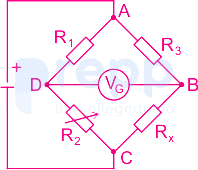
Wheatstone bridge can be used to measure ______.
Controlling Torque in megger is provided by:
High tonnage kettles are generally used in circulation lines with volumes up to _______?
A 60 microampere meter has a resistance of 100 ohms. If the meter has to measure 100 mA, then the value of current through the shunt is
Temperature control in bridge measurement is required because a difference in temperature will cause a difference in:
In a single phase induction type energy meter, maximum torque is produced when the shunt magnetic flux:
Important Questions from Measuring Instruments
Microscope is used for the study of which of the following?
What does a Vernier Caliper measure?
'Anemometer' is an instrument used for measuring the
Instrument used to observe changes in the solar system is :
The Windvane instrument measures the ______.



