
Wheatstone bridge can be used to measure ______.
resistance
Understanding the Wheatstone Bridge for Electrical Measurements
The question asks about the primary quantity that a Wheatstone bridge is used to measure. A Wheatstone bridge is a classic electrical circuit designed for a specific measurement purpose.
What is a Wheatstone Bridge?
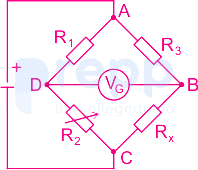
A Wheatstone bridge is an electrical circuit used to measure an unknown electrical resistance by balancing two legs of a bridge circuit, one leg of which includes the unknown component.
The circuit typically consists of:
- Four resistive arms forming a bridge.
- A voltage source connected across one diagonal of the bridge.
- A galvanometer (or sensitive current detector) connected across the other diagonal.
Principle of Operation: Balanced Condition
The Wheatstone bridge operates on the principle of balancing. The bridge is considered balanced when there is no current flowing through the galvanometer connected between the two midpoints of the bridge arms. This happens when the potential difference across the galvanometer is zero.
Consider the standard Wheatstone bridge setup with resistors \(R_1, R_2, R_3, R_x\), where \(R_x\) is the unknown resistance. When the bridge is balanced, the ratio of resistances in the arms is equal:
\(\frac{R_1}{R_2} = \frac{R_3}{R_x}\)
From this balanced condition, if \(R_1, R_2\), and \(R_3\) are known, the unknown resistance \(R_x\) can be calculated as:
\(R_x = R_3 \times \frac{R_2}{R_1}\)
Often, one of the resistors (\(R_1\), \(R_2\), or \(R_3\)) is a variable resistor that is adjusted until the galvanometer shows zero deflection (indicating zero current). Once balanced, the value of the unknown resistance can be determined using the known values of the other resistors.
What the Wheatstone Bridge Measures
Based on its principle of operation and the formula derived from the balanced condition, the Wheatstone bridge is specifically designed and primarily used to measure resistance. It provides a highly sensitive and accurate method for comparing an unknown resistance against known resistances.
Let's look at why the other options are not the primary measurement:
- Power: Power is the rate at which energy is transferred. While power is dissipated by the resistors in the bridge circuit, the bridge itself is not designed to directly measure power. Power involves voltage and current (\(P = VI = I^2R = V^2/R\)).
- Voltage: Voltage is the electric potential difference. While voltage is applied to the bridge and exists across different points, the Wheatstone bridge's core function is based on balancing voltage drops across resistive arms to detect zero current, allowing for resistance calculation, not direct voltage measurement of an arbitrary point or component.
- Current: Current is the flow of electric charge. A galvanometer measures current (specifically, zero current for balance), and current flows through the arms of the bridge. However, the bridge's purpose is not to measure this current value under normal operating conditions (unless specifically trying to determine the imbalance current, but the primary use is finding resistance at zero current). The measurement outcome is the value of the unknown resistance, not a current value.
Therefore, the main application of a standard Wheatstone bridge is the precise measurement of unknown electrical resistance.
| Quantity | Measured by Wheatstone Bridge? | Reason |
|---|---|---|
| Resistance | Yes | Designed to compare unknown resistance with known resistances using a balance principle. |
| Power | No (Directly) | Power is dissipated, but the bridge measures resistance, not power. |
| Voltage | No (Directly) | Voltage is applied and voltage drops are balanced, but the output is resistance. |
| Current | No (Directly) | A galvanometer detects current imbalance, but the goal is zero current to find resistance. |
Revision Table: Key Concepts of Wheatstone Bridge
| Concept | Description |
|---|---|
| Purpose | To accurately measure unknown electrical resistance. |
| Components | Four resistors (forming arms), voltage source, galvanometer. |
| Principle | Balancing the ratio of resistances in the arms. |
| Balanced Condition | Zero current through the galvanometer. |
| Measurement Method | Adjusting a known variable resistance until balance is achieved, then calculating the unknown resistance. |
Additional Information: Wheatstone Bridge Applications and Variations
The Wheatstone bridge is a fundamental circuit with several important applications:
- Strain Gauges: Wheatstone bridges are widely used with strain gauges to measure mechanical strain. Strain gauges change resistance when stretched or compressed, and this small change is detected using a Wheatstone bridge.
- Temperature Measurement: Resistance Temperature Detectors (RTDs) or thermistors, whose resistance changes with temperature, can be incorporated into a Wheatstone bridge to measure temperature.
- Other Sensors: Many sensors that convert a physical quantity (like pressure, light intensity, etc.) into a change in resistance can be used in conjunction with a Wheatstone bridge for measurement.
- Variations: There are variations like the Kelvin bridge, which is designed specifically for measuring very low resistances accurately by mitigating the effects of contact resistance.
The sensitivity of the bridge is highest when the resistances in all four arms are of the same order of magnitude.
In summary, the fundamental and primary purpose of a Wheatstone bridge is the precise measurement of electrical resistance.
Similar Questions
Current is measured using:
Which of the following is not true with respect to the ammeter & voltmeter?
Which of the following devices is used for measuring the speed of DC machines?
How many wattmeter elements are needed at minimum to measure the power of a 3-phase circuit?
Which of the expressions is true for the balanced condition of the following wheatstone bridge?
Controlling Torque in megger is provided by:
High tonnage kettles are generally used in circulation lines with volumes up to _______?
A 60 microampere meter has a resistance of 100 ohms. If the meter has to measure 100 mA, then the value of current through the shunt is
Temperature control in bridge measurement is required because a difference in temperature will cause a difference in:
In a single phase induction type energy meter, maximum torque is produced when the shunt magnetic flux:
Important Questions from Measuring Instruments
Microscope is used for the study of which of the following?
What does a Vernier Caliper measure?
'Anemometer' is an instrument used for measuring the
Instrument used to observe changes in the solar system is :
The Windvane instrument measures the ______.



