
Which of the following is not true with respect to the ammeter & voltmeter?
Ammeter has high resistance and voltmeter has low resistance
Understanding Ammeter and Voltmeter Properties
Let's analyze the properties and connections of ammeters and voltmeters in an electrical circuit to determine which statement is incorrect.
An ammeter is a device used to measure the electric current flowing through a component in a circuit. To measure the current accurately without significantly altering the circuit's behavior, an ideal ammeter should have zero resistance. Real ammeters have very low resistance.
A voltmeter is a device used to measure the electric potential difference (voltage) across a component in a circuit. To measure the voltage accurately without drawing significant current from the component, an ideal voltmeter should have infinite resistance. Real voltmeters have very high resistance.
Now let's look at how these instruments are connected in a circuit:
- Ammeter Connection: To measure the current flowing through a component, the ammeter must be placed directly in the path of the current. This means the ammeter is always connected in series with the component whose current is being measured. Connecting an ammeter in series requires breaking or opening the circuit to insert the ammeter.
- Voltmeter Connection: To measure the voltage across a component, the voltmeter must be connected across the two points between which the potential difference is to be measured. This means the voltmeter is always connected in parallel with the component. Connecting a voltmeter in parallel does not require breaking the circuit; you simply connect the voltmeter's terminals to the points across the component.
Analyzing Each Statement about Ammeters and Voltmeters
Let's evaluate each of the given options:
- Statement 1: "Ammeter has high resistance and voltmeter has low resistance"
This statement claims ammeters have high resistance and voltmeters have low resistance. Based on our understanding, ammeters are designed to have very low resistance (ideally zero) and voltmeters are designed to have very high resistance (ideally infinite) to minimize their impact on the circuit being measured. Therefore, this statement is the opposite of the true characteristics.
- Statement 2: "Ammeter is connected in series and the voltmeter is connected in parallel"
This statement correctly describes the standard method of connecting ammeters and voltmeters in a circuit. Ammeters are always connected in series to measure current through a point, and voltmeters are always connected in parallel to measure voltage across a component.
- Statement 3: "Connecting the ammeter to the circuit requires disassembling the circuit."
Since an ammeter must be connected in series, the circuit path must be broken to insert the ammeter. This process is effectively disassembling or interrupting the circuit. This statement is true.
- Statement 4: "A voltmeter can be connected without disconnecting the circuit"
Since a voltmeter is connected in parallel across a component, it does not need to be inserted into the main current path. You can connect the voltmeter's probes to the required points without breaking the circuit. This statement is true.
Conclusion on Incorrect Statement
Comparing the analysis of each statement, statement 1 is the only one that is false regarding the typical properties of ammeters and voltmeters.
The statement that is not true is: Ammeter has high resistance and voltmeter has low resistance.
Revision Table: Ammeter vs. Voltmeter
| Feature | Ammeter | Voltmeter |
|---|---|---|
| Measures | Electric Current (I) | Electric Potential Difference (V) |
| Ideal Resistance | $0 \, \Omega$ (Zero) | $\infty \, \Omega$ (Infinite) |
| Real Resistance | Very Low | Very High |
| Connection in Circuit | Series | Parallel |
| Requires Circuit Disassembly | Yes | No |
Additional Information: Impact of Incorrect Resistance
The low resistance of an ammeter is crucial because if it had high resistance, it would impede the current flow in the series circuit, leading to an inaccurate reading of the original current. Similarly, the high resistance of a voltmeter is crucial because if it had low resistance, it would draw significant current from the component it is connected across (in parallel), thus changing the voltage across that component and resulting in an inaccurate reading.
Understanding the ideal and practical resistance values and the correct connection methods (series for ammeter, parallel for voltmeter) is fundamental for correctly using these instruments and interpreting circuit measurements.
Similar Questions
Current is measured using:
Which of the following devices is used for measuring the speed of DC machines?
How many wattmeter elements are needed at minimum to measure the power of a 3-phase circuit?
Which of the expressions is true for the balanced condition of the following wheatstone bridge?
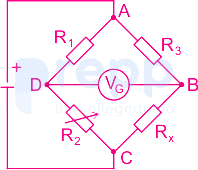
Wheatstone bridge can be used to measure ______.
Controlling Torque in megger is provided by:
High tonnage kettles are generally used in circulation lines with volumes up to _______?
A 60 microampere meter has a resistance of 100 ohms. If the meter has to measure 100 mA, then the value of current through the shunt is
Temperature control in bridge measurement is required because a difference in temperature will cause a difference in:
In a single phase induction type energy meter, maximum torque is produced when the shunt magnetic flux:
Important Questions from Measuring Instruments
Microscope is used for the study of which of the following?
What does a Vernier Caliper measure?
'Anemometer' is an instrument used for measuring the
Instrument used to observe changes in the solar system is :
The Windvane instrument measures the ______.



