
Controlling Torque in megger is provided by:
coil
Understanding the Megger and its Torque
A megger, short for megohm-meter, is a portable instrument used for measuring high electrical insulation resistances. It works on the principle of electromagnetic induction and requires a voltage source, which is often a hand-cranked generator or a battery-operated electronic circuit.
For any pointer-type electrical measuring instrument to provide a stable reading, two opposing torques are essential:
- Deflecting Torque: This torque causes the pointer to move from its zero position. In a megger, the deflecting torque is produced by the current flowing through the instrument, which depends on the resistance being measured.
- Controlling Torque: This torque opposes the deflecting torque. It increases as the pointer deflection increases. The pointer comes to rest at a position where the deflecting torque is balanced by the controlling torque.
Controlling Torque Mechanism in a Megger
In many electrical instruments, the controlling torque is provided by springs (like in PMMC instruments) or by gravity (in some vertical-scale instruments). However, a megger uses a different mechanism for providing the controlling torque.
In a typical megger, the controlling torque is provided by one or more voltage coils, sometimes referred to as pressure coils. These coils are connected across the voltage source and are positioned relative to the deflecting coil and the magnetic field in such a way that they produce a torque that opposes the deflecting torque. The strength of this controlling torque depends on the voltage of the source (which is relatively constant during a measurement) and the position of the coils.
The arrangement of the deflecting coil and the control coil(s) ensures that the pointer position is determined by the ratio of the current through the resistance being measured (influencing deflecting torque) to the current through the voltage coil (influencing controlling torque). This makes the instrument indicate resistance directly, often on a scale calibrated in ohms and megohms.
Therefore, the element responsible for the controlling torque in a megger is the coil system.
Detailed Analysis of Options
- Gravity: Gravity control is used in some vertically mounted instruments, but not typically in a portable megger. It relies on the weight of the pointer or an attached weight.
- Coil: In a megger, coils (specifically voltage or pressure coils) are used to provide the necessary controlling torque.
- Eddy current: Eddy currents are primarily used for damping torque, which brings the pointer to rest quickly, not for controlling torque.
- Battery: The battery provides the voltage source for the megger's operation, generating the current that creates the deflecting and controlling torques, but it does not *directly* provide the controlling torque itself. The torque is produced by the interaction of magnetic fields generated by currents from the battery (or generator) flowing through the coils.
Revision Table: Comparison of Control Mechanisms
| Control Mechanism | Used In | How it Works | Megger Application |
|---|---|---|---|
| Spring Control | PMMC, Electrodynamometer | Hairsprings provide restoring torque proportional to angle | Not used for control |
| Gravity Control | Some vertical-scale instruments | Weight provides restoring torque proportional to sine of angle | Not used for control |
| Coil Control (Voltage/Pressure Coils) | Megger, Power Factor Meter | Voltage coils positioned to provide opposing torque | Primary control mechanism in Megger |
Additional Information: Megger Components
Beyond the torque-producing elements, a megger typically includes:
- A hand-cranked DC generator or electronic DC voltage source to supply the test voltage (often 500V, 1000V, 2500V, or 5000V).
- A pointer and a calibrated scale (reading in Ohms and Megohms).
- Terminals for connecting to the circuit under test (usually 'Line', 'Earth', and sometimes 'Guard').
Understanding the role of the coils in providing the controlling torque is crucial to understanding how a megger measures high resistance values accurately.
Similar Questions
Current is measured using:
Which of the following is not true with respect to the ammeter & voltmeter?
Which of the following devices is used for measuring the speed of DC machines?
How many wattmeter elements are needed at minimum to measure the power of a 3-phase circuit?
Which of the expressions is true for the balanced condition of the following wheatstone bridge?
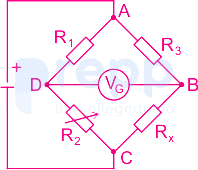
Wheatstone bridge can be used to measure ______.
High tonnage kettles are generally used in circulation lines with volumes up to _______?
A 60 microampere meter has a resistance of 100 ohms. If the meter has to measure 100 mA, then the value of current through the shunt is
Temperature control in bridge measurement is required because a difference in temperature will cause a difference in:
In a single phase induction type energy meter, maximum torque is produced when the shunt magnetic flux:
Important Questions from Measuring Instruments
Microscope is used for the study of which of the following?
What does a Vernier Caliper measure?
'Anemometer' is an instrument used for measuring the
Instrument used to observe changes in the solar system is :
The Windvane instrument measures the ______.



