
Temperature control in bridge measurement is required because a difference in temperature will cause a difference in:
Resistance
Understanding Bridge Measurements and Temperature Effects
Bridge circuits, such as the Wheatstone bridge, are widely used for precise measurement of electrical quantities like resistance, inductance, and capacitance. These circuits work by balancing the impedances of different arms of the bridge. When the bridge is balanced, there is no voltage difference between the output terminals, and the unknown component value can be determined from the known values of other components in the bridge.
The accuracy of a bridge measurement heavily depends on the stability of the component values in the bridge arms. However, component values can change due to various environmental factors, with temperature being one of the most significant.
Why Temperature Impacts Bridge Measurements
Different materials and components react differently to changes in temperature. This thermal sensitivity means that variations in ambient temperature or temperature gradients across the circuit can cause the values of resistors, inductors, and capacitors to drift from their nominal values. This drift directly affects the balance condition of the bridge, leading to inaccurate measurements.
Temperature Effect on Component Values
- Resistance: The resistance of most conductive materials changes significantly with temperature. This relationship is often approximated by a linear model for small temperature changes: \(R_T = R_{ref} (1 + \alpha (T - T_{ref}))\), where \(R_T\) is the resistance at temperature \(T\), \(R_{ref}\) is the resistance at a reference temperature \(T_{ref}\), and \(\alpha\) is the temperature coefficient of resistance. This coefficient is positive for most metals (resistance increases with temperature) and negative for some semiconductors and insulators. Carbon film resistors typically have negative coefficients, while metal film resistors have lower positive coefficients.
- Capacitance: The capacitance of a capacitor depends on the dielectric material's permittivity, the plate area, and the distance between plates. Permittivity and physical dimensions can change with temperature, causing capacitance to vary. The temperature coefficient of capacitance varies greatly depending on the dielectric material (e.g., ceramic types, polyester, mica). Some materials have very low temperature coefficients, while others are highly sensitive.
- Inductance: The inductance of an inductor depends on its geometry, the number of turns, and the permeability of the core material (if any). Temperature changes can cause physical expansion/contraction of the coil and core, altering the geometry. The permeability of magnetic core materials is particularly sensitive to temperature changes, especially near their Curie temperature.
| Component | Primary Factor Affected by Temperature | General Sensitivity |
|---|---|---|
| Resistor | Resistivity of material, physical dimensions | Typically moderate to high (varies by type) |
| Capacitor | Dielectric permittivity, physical dimensions | Varies widely (some types very stable, others sensitive) |
| Inductor | Physical dimensions, core material permeability | Varies (especially sensitive with magnetic cores) |
Why Resistance is Often the Key Concern
While temperature affects all three parameters (resistance, inductance, and capacitance), resistance is frequently the most sensitive component in many common bridge configurations, such as the Wheatstone bridge, which is specifically designed for resistance measurement. In AC bridges used for impedance measurements (which involve resistance, inductance, and capacitance), changes in resistance due to temperature can significantly alter the magnitude and phase balance conditions.
Furthermore, the temperature coefficients of resistance for common materials used in precision resistors are well-characterized but can still lead to significant errors if temperature is not controlled or accounted for, especially when measuring small changes in resistance (e.g., in strain gauge applications).
Therefore, ensuring a stable and uniform temperature environment for the bridge components is crucial to minimize changes in their values, thereby maintaining the accuracy of the measurement. A difference in temperature between the arms of the bridge will cause a difference in the component values, primarily affecting resistance due to its direct dependence on temperature and the common use of resistance-based bridges.
Conclusion on Temperature Control in Bridge Measurement
Temperature control in bridge measurement is essential because temperature variations cause the electrical properties of the components (resistors, capacitors, inductors) to change. Among these, the resistance of materials is typically quite sensitive to temperature fluctuations. A difference in temperature across the bridge arms directly leads to a difference in the values of the components, significantly impacting the bridge balance and the accuracy of the measurement. Therefore, temperature control is primarily required because a difference in temperature will cause a difference in resistance.
Revision Table: Key Concepts
| Concept | Explanation | Relevance to Bridge Measurement |
|---|---|---|
| Bridge Circuit | Electrical circuit for precise measurement by balancing impedances. | Foundation for accurate measurements of R, L, C. |
| Bridge Balance | Condition where bridge output is zero due to balanced arm impedances. | Indicates the measured value. Sensitivity depends on component stability. |
| Temperature Coefficient | Measure of how a component's value changes per degree of temperature change. | Determines the magnitude of temperature-induced error. |
| Temperature Control | Maintaining a stable and uniform temperature. | Minimizes component value changes and improves measurement accuracy. |
Additional Information: Mitigating Temperature Effects
Beyond strict temperature control, several techniques are used to minimize temperature-induced errors in bridge measurements:
- Using Components with Low Temperature Coefficients: Selecting precision resistors, capacitors, and inductors made from materials with very low temperature coefficients (\(TC\)). For example, Manganin or Constantan alloys are used for standard resistors due to their low \(TCR\).
- Matching Components: Using components with similar temperature coefficients in corresponding arms of the bridge so that temperature changes affect them symmetrically, maintaining balance.
- Temperature Compensation: Incorporating additional components (like thermistors or sensing resistors) whose temperature characteristics are used to counteract the temperature-induced changes in the main measurement components.
- Shielding and Insulation: Protecting the bridge circuit from thermal radiation and air currents.
- Controlled Environment: Performing measurements in temperature-controlled rooms or using temperature chambers.
These techniques highlight the critical importance of addressing temperature variations to achieve high accuracy in bridge-based measurements.
Similar Questions
Current is measured using:
Which of the following is not true with respect to the ammeter & voltmeter?
Which of the following devices is used for measuring the speed of DC machines?
How many wattmeter elements are needed at minimum to measure the power of a 3-phase circuit?
Which of the expressions is true for the balanced condition of the following wheatstone bridge?
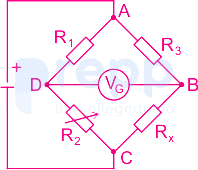
Wheatstone bridge can be used to measure ______.
Controlling Torque in megger is provided by:
High tonnage kettles are generally used in circulation lines with volumes up to _______?
A 60 microampere meter has a resistance of 100 ohms. If the meter has to measure 100 mA, then the value of current through the shunt is
In a single phase induction type energy meter, maximum torque is produced when the shunt magnetic flux:
Important Questions from Measuring Instruments
Microscope is used for the study of which of the following?
What does a Vernier Caliper measure?
'Anemometer' is an instrument used for measuring the
Instrument used to observe changes in the solar system is :
The Windvane instrument measures the ______.



