Assertion A : The first ionization enthalpy of O is lower than that of N and F.
Reason R : The loss of an electron from O leads to stable half-filled p orbital.
In light of the above statements, choose the most appropriate answer from the options given below:
Assertion A: The first ionization enthalpy of O is lower than that of N and F.
Reason R: The loss of an electron from O leads to stable half-filled p orbital.
Analyzing Ionization Enthalpy
First ionization enthalpy ($\Delta H_{IE1}$) is the minimum energy required to remove the most loosely bound electron from a neutral gaseous atom in its ground state.
- General Trend: Across a period, ionization enthalpy generally increases due to increasing effective nuclear charge. Therefore, we expect $\Delta H_{IE1}$(N) < $\Delta H_{IE1}$(O) < $\Delta H_{IE1}$(F).
- Electron Configurations:
- Nitrogen (N, Z=7): $1s^2 2s^2 2p^3$ (half-filled $2p$ subshell - stable)
- Oxygen (O, Z=8): $1s^2 2s^2 2p^4$ (paired electron in $2p$ subshell)
- Fluorine (F, Z=9): $1s^2 2s^2 2p^5$
- Comparison:
- N vs O: Removing an electron from Nitrogen requires breaking the stable half-filled $2p$ configuration. Removing the first electron from Oxygen results in a stable half-filled $2p^3$ configuration ($2p^4 \rightarrow 2p^3$). This stabilization makes it easier to remove an electron from Oxygen compared to Nitrogen. Thus, $\Delta H_{IE1}$(O) < $\Delta H_{IE1}$(N).
- O vs F: While Fluorine has a higher nuclear charge, the stability of the half-filled $2p$ orbital in Oxygen affects the trend. However, the general increase across the period holds, and $\Delta H_{IE1}$(O) < $\Delta H_{IE1}$(F).
- Conclusion on Assertion A: Assertion A states that $\Delta H_{IE1}$(O) is lower than both $\Delta H_{IE1}$(N) and $\Delta H_{IE1}$(F). This is correct due to the specific stability considerations.
Evaluating the Reason
Reason R states that losing an electron from Oxygen leads to a stable half-filled p orbital. Oxygen's electron configuration is $2p^4$. When one electron is removed, the configuration becomes $2p^3$, which is a half-filled $p$ subshell and is known for its stability. This statement is factually correct.
Connecting Assertion and Reason
The reason explains the anomaly in the ionization enthalpy trend. The dip in ionization enthalpy from Nitrogen to Oxygen occurs precisely because removing an electron from Oxygen allows it to achieve the highly stable half-filled $2p$ orbital configuration ($2p^3$). This stability gained upon ionization makes the process energetically favorable compared to removing an electron from Nitrogen, which already possesses this stable configuration. Therefore, Reason R correctly explains Assertion A.
Final Choice
Both Assertion A and Reason R are correct, and Reason R provides the correct explanation for Assertion A.
This corresponds to Option 4.
Similar Questions
Identify the correct statement about $ClF_3$ from the following options :
Match List I with List II :
List I (Transition metal/compound) List II (Catalytic Role) A. $V_2O_5$ I. Preparation of ammonia from $N_2/H_2$ mixture B. Fe II. Polymerisation of alkynes C. $PdCl_2$ III. Preparation of $H_2SO_4$ from $SO_2$ D. Ni complex IV. Oxidation of ethyne to ethanal Choose the correct answer :
Match List I with List II :
List I (Complex/Ion) List II (Shape/geometry) A. $[Pt(Cl)_2(NH_3)_2]$ I. Octahedral B. $[Co(NH_3)_6]Cl_3$ II. Trigonal bipyramidal C. $[NiCl_4]^{2-}$ III. Square planar D. $[Fe(CO)_5]$ IV. Tetrahedral Choose the correct answer :
- Identify the incorrect statement from the following :
- Methane reacts with steam at $1273 \text{ K}$ in the presence of nickel catalyst to form :
Match List I with List II :
List I (Complex) List II (Type of Isomerism) A. $[Pt(NH_3)_2Cl_2]$ I. Optical B. $[Co(en)_3]^{3+}$ II. Solvate C. $[Co(NH_3)_4(NO_2)_2]Cl$ III. Geometrical D. $[Cr(H_2O)_6]Cl_3$ IV. Linkage Choose the correct answer :
- The calculated 'spin-only' magnetic moment of $Ti^{2+}$ ($3d^2$) is :
- Although +3 oxidation state is most common in lanthanoids, cerium shows +4 oxidation state because :
- Identify the incorrect statement from the following :
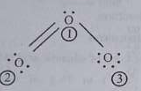
The correct formal charges on oxygen atoms numbered 2, 1 and 3 respectively in ozone are :
Important Questions from Inorganic Chemistry
- A 'p'-block element (E) and hydrogen form a binary cation $(\text{EH}_x)^+$, while $\text{EH}_3$ on treatment with $\text{K}_2\text{HgI}_4$ in alkaline medium gives a precipitate of basic mercury(II)amido-iodine. Given below are first ionisation enthalpy values ($\text{kJ mol}^{-1}$) for first element each from group 13, 14, 15 and 16. Identify the correct first ionisation enthalpy value for element E.
- $[\text{Ni}(\text{PPh}_3)_2\text{Cl}_2]$ is a paramagnetic complex. Identify the INCORRECT statements about this complex.
A. The complex exhibits geometrical isomerism.
B. The complex is white in colour.
C. The calculated spin-only magnetic moment of the complex is 2.84 BM.
D. The calculated CFSE (Crystal Field Stabilization Energy) of Ni in this complex is $-0.8 \, \Delta_0$.
E. The geometrical arrangement of ligands in this complex is similar to that in $\text{Ni(CO)}_4$.
Choose the correct answer from the options given below : - Given below are two statements :
Statement I : The first ionization enthalpy of Cr is lower than that of Mn.
Statement II : The second and third ionization enthalpies of Cr are higher than those of Mn.
In the light of the above statements, choose the correct answer from the options given below : - Among $\text{H}_2\text{S, H}_2\text{O, NF}_3, \text{NH}_3 \text{ and CHCl}_3$, identify the molecule (X) with lowest dipole moment value. The number of lone pairs of electrons present on the central atom of the molecule (X) is :
- Given below are two statements :
Statement I : Elements 'X' and 'Y' are the most and least electronegative elements, respectively among N, As, Sb and P. The nature of the oxides $\text{X}_2\text{O}_3$ and $\text{Y}_2\text{O}_3$ is acidic and amphoteric, respectively.
Statement II : $\text{BCl}_3$ is covalent in nature and gets hydrolysed in water. It produces $[\text{B(OH)}_4]^-$ and $[\text{B(H}_2\text{O)}_6]^{3+}$ in aqueous medium.
In the light of the above statements, choose the correct answer from the options given below :