Question
The correct formal charges on oxygen atoms numbered 2, 1 and 3 respectively in ozone are :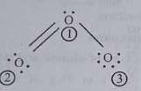
This question was previously asked in
NEET UG Re-Exam 2026 Question Paper (21-Jun-2026)
The correct answer is
0, +1, -1
Step-by-step Solution:
To determine the formal charges on the oxygen atoms in ozone (\(O_3\)), we need to analyze its structure and use the formula for calculating formal charge:
\(\text{Formal Charge} = \text{Valence Electrons} - \text{Non-bonding Electrons} - \frac{\text{Bonding Electrons}}{2}\)
- Structure of Ozone: The ozone molecule has a bent shape with a resonance structure. The central oxygen atom is bonded to two other oxygen atoms.
- Oxygen number 1 (central): Forms a double bond with one oxygen and a single bond with another.
- Oxygen number 2: Forms a single bond with the central oxygen.
- Oxygen number 3: Forms a double bond with the central oxygen.
- Calculate Formal Charge:
- Oxygen 2:
- Valence electrons = 6 (for oxygen)
- Non-bonding electrons = 6
- Bonding electrons = 2 (single bond with central oxygen)
- \(\text{Formal Charge} = 6 - 6 - \frac{2}{2} = 0\)
- Oxygen 1 (central):
- Valence electrons = 6
- Non-bonding electrons = 4
- Bonding electrons = 6 (in a single and a double bond)
- \(\text{Formal Charge} = 6 - 4 - \frac{6}{2} = +1\)
- Oxygen 3:
- Valence electrons = 6
- Non-bonding electrons = 4
- Bonding electrons = 4 (double bond with central oxygen)
- \(\text{Formal Charge} = 6 - 4 - \frac{4}{2} = -1\)
- Oxygen 2:
- Conclusion: The correct formal charges on the oxygen atoms numbered 2, 1, and 3 in ozone are 0, +1, and -1 respectively. Thus, the correct answer is: 0, +1, -1.
Was this answer helpful?
Similar Questions
Match List I with List II :
List I (Transition metal/compound) List II (Catalytic Role) A. $V_2O_5$ I. Preparation of ammonia from $N_2/H_2$ mixture B. Fe II. Polymerisation of alkynes C. $PdCl_2$ III. Preparation of $H_2SO_4$ from $SO_2$ D. Ni complex IV. Oxidation of ethyne to ethanal Choose the correct answer :
Match List I with List II :
List I (Complex/Ion) List II (Shape/geometry) A. $[Pt(Cl)_2(NH_3)_2]$ I. Octahedral B. $[Co(NH_3)_6]Cl_3$ II. Trigonal bipyramidal C. $[NiCl_4]^{2-}$ III. Square planar D. $[Fe(CO)_5]$ IV. Tetrahedral Choose the correct answer :
Match List I with List II :
List I (Complex) List II (Type of Isomerism) A. $[Pt(NH_3)_2Cl_2]$ I. Optical B. $[Co(en)_3]^{3+}$ II. Solvate C. $[Co(NH_3)_4(NO_2)_2]Cl$ III. Geometrical D. $[Cr(H_2O)_6]Cl_3$ IV. Linkage Choose the correct answer :
- The calculated 'spin-only' magnetic moment of $Ti^{2+}$ ($3d^2$) is :
- Identify the incorrect statement from the following :
- Which one of the following is an ambidentate ligand ?
- Identify the incorrect statement from the following :
- Match the species in List I with their geometry in List II
List I List II A. $PCl_5$ I. Tetrahedral B. $BrF_5$ II. Square Planar C. $BF_4^-$ III. Trigonal bipyramidal D. $[Ni(CN)_4]^{2-}$ IV. Square pyramidal
Choose the correct answer from the options given below: - Given below are two statements : One is labelled as Assertion A and the other is labelled as Reason R.
Assertion A : The first ionization enthalpy of O is lower than that of N and F.
Reason R : The loss of an electron from O leads to stable half-filled p orbital.
In light of the above statements, choose the most appropriate answer from the options given below: - According to crystal field theory, the correct order of ligands with respect to their decreasing order of field strength is
Important Questions from Inorganic Chemistry
- A chromium complex with a formula $\text{CrCl}_3\cdot 6\text{H}_2\text{O}$ has a spin only magnetic moment value of $3.87 \text{ BM}$ and its solution conductivity corresponds to $1 : 2$ electrolyte. $2.75 \text{ g}$ of the complex solution was initially passed through a cation exchanger. The solution obtained after the process was reacted with excess of $\text{AgNO}_3$. The amount of $\text{AgCl}$ formed in the above process is _____ g. (Nearest integer)
[Given: Molar mass in $\text{g mol}^{-1}$ $\text{Cr} : 52; \text{Cl}: 35.5, \text{Ag}: 108, \text{O}: 16, \text{H}: 1$] - Consider the following reactions :
$\text{NaCl} + \text{K}_2\text{Cr}_2\text{O}_7 + \text{H}_2\text{SO}_4 \rightarrow \text{A} + \text{KHSO}_4 + \text{NaHSO}_4 + \text{H}_2\text{O}$
$\text{A} + \text{NaOH} \rightarrow \text{B} + \text{NaCl} + \text{H}_2\text{O}$
$\text{B} + \text{H}_2\text{SO}_4 + \text{H}_2\text{O}_2 \rightarrow \text{C} + \text{Na}_2\text{SO}_4 + \text{H}_2\text{O}$
In the product 'C', 'X' is the number of $\text{O}_2^{2-}$ units, 'Y' is the total number oxygen atoms present and 'Z' is the oxidation state of Cr. The value of X + Y + Z is ____________. - Identify the metal ions among $\text{Co}^{2+}, \text{Ni}^{2+}, \text{Fe}^{2+}, \text{V}^{3+}$ and $\text{Ti}^{2+}$ having a spin-only magnetic moment value more than $3.0\text{ BM}$. The sum of unpaired electrons present in the high spin octahedral complexes formed by those metal ions is __________.
The crystal field splitting energy of $[\text{Co(oxalate)}_3]^{3-}$ complex is '$n$' times that of the $[\text{Cr(oxalate)}_3]^{3-}$ complex. Here '$n$' is ___________. (Assume $\Delta_o >> P$)
- Which of the following is the structure of pyrosulphuric acid?
Need Expert Advice?
More Questions from NEET