Pyrosulphuric Acid Structure Identification
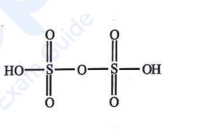
Pyrosulphuric acid, also known as disulfuric acid, has the chemical formula $H_2S_2O_7$. Its structure is characterized by two sulfuric acid ($H_2SO_4$) units joined by an oxygen atom, forming a central sulfur-oxygen-sulfur (S-O-S) bridge.
The structure consists of:
- Two sulfur atoms (S).
- Seven oxygen atoms (O).
- Two hydrogen atoms (H).
- A central oxygen atom linking the two sulfur atoms.
- Each sulfur atom is bonded to the bridging oxygen, two additional oxygen atoms (one commonly depicted as a double bond), and one hydrogen atom.
The image corresponding to Option D depicts this specific arrangement, correctly representing the molecular structure of pyrosulphuric acid ($H_2S_2O_7$).
Correct Structure Image:
Similar Questions
- The correct order of conductivity of $0.001\text{ (M)}$ separate aqueous solutions of $[Pt(NH_3)_6]Cl_4\text{ (i)}$; $[Cr(NH_3)_6]Cl_3\text{ (ii)}$; $[Co(NH_3)_4Cl_2]Cl\text{ (iii)}$ and $K_2PtCl_6\text{ (iv)}$ each containing octahedral complex species is
- Borazole is prepared by heating the product isolated by reacting
The calculated magnetic moment for low spin $[Ru(EDTA)]^-$ is

- Among $\text{N}_{2}\text{O}, \text{ClF}_{2}^{-}, \text{SO}_{2}$ and $\text{I}_{3}^{+}$, the species having the linear structures are
- Peroxide ion is
- In which of the following species, $sp^3d^2$ hybridisation is not associated?
- For the metal complex $[Co(NH_3)_5SO_4]Br$, coordination number, oxidation number, number of d-electrons and number of unpaired d-electrons are respectively
- Which of the following have tetrahedral structures?
Nickel combines with a uninegative monodentate ligand (X−) to form a paramagnetic complex [NiX4]2−. The hybridisation involved and number of unpaired electrons present in the complex are respectively
Which of the following statements is incorrect ?
Important Questions from Inorganic Chemistry
- A chromium complex with a formula $\text{CrCl}_3\cdot 6\text{H}_2\text{O}$ has a spin only magnetic moment value of $3.87 \text{ BM}$ and its solution conductivity corresponds to $1 : 2$ electrolyte. $2.75 \text{ g}$ of the complex solution was initially passed through a cation exchanger. The solution obtained after the process was reacted with excess of $\text{AgNO}_3$. The amount of $\text{AgCl}$ formed in the above process is _____ g. (Nearest integer)
[Given: Molar mass in $\text{g mol}^{-1}$ $\text{Cr} : 52; \text{Cl}: 35.5, \text{Ag}: 108, \text{O}: 16, \text{H}: 1$] - Consider the following reactions :
$\text{NaCl} + \text{K}_2\text{Cr}_2\text{O}_7 + \text{H}_2\text{SO}_4 \rightarrow \text{A} + \text{KHSO}_4 + \text{NaHSO}_4 + \text{H}_2\text{O}$
$\text{A} + \text{NaOH} \rightarrow \text{B} + \text{NaCl} + \text{H}_2\text{O}$
$\text{B} + \text{H}_2\text{SO}_4 + \text{H}_2\text{O}_2 \rightarrow \text{C} + \text{Na}_2\text{SO}_4 + \text{H}_2\text{O}$
In the product 'C', 'X' is the number of $\text{O}_2^{2-}$ units, 'Y' is the total number oxygen atoms present and 'Z' is the oxidation state of Cr. The value of X + Y + Z is ____________. - Identify the metal ions among $\text{Co}^{2+}, \text{Ni}^{2+}, \text{Fe}^{2+}, \text{V}^{3+}$ and $\text{Ti}^{2+}$ having a spin-only magnetic moment value more than $3.0\text{ BM}$. The sum of unpaired electrons present in the high spin octahedral complexes formed by those metal ions is __________.
The crystal field splitting energy of $[\text{Co(oxalate)}_3]^{3-}$ complex is '$n$' times that of the $[\text{Cr(oxalate)}_3]^{3-}$ complex. Here '$n$' is ___________. (Assume $\Delta_o >> P$)
- The correct order of conductivity of $0.001\text{ (M)}$ separate aqueous solutions of $[Pt(NH_3)_6]Cl_4\text{ (i)}$; $[Cr(NH_3)_6]Cl_3\text{ (ii)}$; $[Co(NH_3)_4Cl_2]Cl\text{ (iii)}$ and $K_2PtCl_6\text{ (iv)}$ each containing octahedral complex species is