The largest and the smallest species among $Mg$ , $Mg^2$, $Al$ and $Al^{3+}$ are Al and $Mg^{2+}$ respectively
Given species:
Mg, Mg2+, Al and Al3+
We compare their sizes.
Cations are smaller than their parent atoms because loss of electrons increases effective nuclear attraction.
Across a period, atomic size decreases from Mg to Al.
Thus:
Mg is larger than Al
Mg2+ is larger than Al3+ (both are isoelectronic, but Al3+ has greater nuclear charge, so it is smaller)
Correct order of size:
Mg > Al > Mg2+ > Al3+
Therefore:
Largest species = Mg
Smallest species = Al3+
Hence the statement , largest is Al and smallest is Mg2+ is incorrect.
Similar Questions
Identify the correct statement about $ClF_3$ from the following options :
Match List I with List II :
List I (Transition metal/compound) List II (Catalytic Role) A. $V_2O_5$ I. Preparation of ammonia from $N_2/H_2$ mixture B. Fe II. Polymerisation of alkynes C. $PdCl_2$ III. Preparation of $H_2SO_4$ from $SO_2$ D. Ni complex IV. Oxidation of ethyne to ethanal Choose the correct answer :
Match List I with List II :
List I (Complex/Ion) List II (Shape/geometry) A. $[Pt(Cl)_2(NH_3)_2]$ I. Octahedral B. $[Co(NH_3)_6]Cl_3$ II. Trigonal bipyramidal C. $[NiCl_4]^{2-}$ III. Square planar D. $[Fe(CO)_5]$ IV. Tetrahedral Choose the correct answer :
- Methane reacts with steam at $1273 \text{ K}$ in the presence of nickel catalyst to form :
Match List I with List II :
List I (Complex) List II (Type of Isomerism) A. $[Pt(NH_3)_2Cl_2]$ I. Optical B. $[Co(en)_3]^{3+}$ II. Solvate C. $[Co(NH_3)_4(NO_2)_2]Cl$ III. Geometrical D. $[Cr(H_2O)_6]Cl_3$ IV. Linkage Choose the correct answer :
- The calculated 'spin-only' magnetic moment of $Ti^{2+}$ ($3d^2$) is :
- Although +3 oxidation state is most common in lanthanoids, cerium shows +4 oxidation state because :
- Identify the incorrect statement from the following :
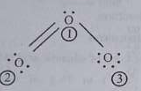
The correct formal charges on oxygen atoms numbered 2, 1 and 3 respectively in ozone are :
- Which one of the following is an ambidentate ligand ?
Important Questions from Inorganic Chemistry
- A 'p'-block element (E) and hydrogen form a binary cation $(\text{EH}_x)^+$, while $\text{EH}_3$ on treatment with $\text{K}_2\text{HgI}_4$ in alkaline medium gives a precipitate of basic mercury(II)amido-iodine. Given below are first ionisation enthalpy values ($\text{kJ mol}^{-1}$) for first element each from group 13, 14, 15 and 16. Identify the correct first ionisation enthalpy value for element E.
- $[\text{Ni}(\text{PPh}_3)_2\text{Cl}_2]$ is a paramagnetic complex. Identify the INCORRECT statements about this complex.
A. The complex exhibits geometrical isomerism.
B. The complex is white in colour.
C. The calculated spin-only magnetic moment of the complex is 2.84 BM.
D. The calculated CFSE (Crystal Field Stabilization Energy) of Ni in this complex is $-0.8 \, \Delta_0$.
E. The geometrical arrangement of ligands in this complex is similar to that in $\text{Ni(CO)}_4$.
Choose the correct answer from the options given below : - Given below are two statements :
Statement I : The first ionization enthalpy of Cr is lower than that of Mn.
Statement II : The second and third ionization enthalpies of Cr are higher than those of Mn.
In the light of the above statements, choose the correct answer from the options given below : - Among $\text{H}_2\text{S, H}_2\text{O, NF}_3, \text{NH}_3 \text{ and CHCl}_3$, identify the molecule (X) with lowest dipole moment value. The number of lone pairs of electrons present on the central atom of the molecule (X) is :
- Given below are two statements :
Statement I : Elements 'X' and 'Y' are the most and least electronegative elements, respectively among N, As, Sb and P. The nature of the oxides $\text{X}_2\text{O}_3$ and $\text{Y}_2\text{O}_3$ is acidic and amphoteric, respectively.
Statement II : $\text{BCl}_3$ is covalent in nature and gets hydrolysed in water. It produces $[\text{B(OH)}_4]^-$ and $[\text{B(H}_2\text{O)}_6]^{3+}$ in aqueous medium.
In the light of the above statements, choose the correct answer from the options given below :