
A solid cylinder has a base of radius 14 cm and height 15 cm. 4 identical cylinders are cut from each base as shown in the given figure. Height of small cylinder is 5 cm. What is the total surface area (in cm 2) of the remaining part?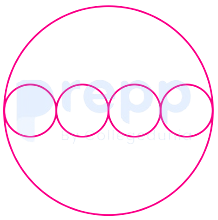
3432
Radius of larger cylinder = 14 cm and height = 15 cm
Radius of smaller cylinders = 28/8 = 7/2 cm and height = 5 cm
When the cylinders are cut as given in the question, the curved surface area of the
Remaining part will increase and CSA of the smaller cylinders will add up. While base area Will decrease by area of one base and increase by area of another base of the smaller
Cylinders thus no increment in base area.
CSA of the remaining part = 2πrh + 8 × 2πr 1h 1 (∵ There are two bases(top + base) in a cylinder and according to question, 4 small cylinders are cut out from each base ∴ we multiplied it by 8)
⇒ 2 × 22/7 (14 × 15 + 8 × 5 × 7/2)
⇒ 2 × 22/7 × 350
⇒ 2200 cm 2
Total Base Area of remaining part = 2πr 2– 8πr 12 + 8πr 12
⇒ 2 × 22/7 × 196
⇒ 1232 cm 2
Total surface area of the remaining part = 2200 + 1232 = 3432 cm 2
 Alternate Method
Diameter of small circle (D) is 2r.
So, AB = 4 × D = 4 × 2r = 8r = Diameter of large cylinder
So, 14 × 2 = 8r
⇒ r = 7/ 2 cm
Here
Total Surface Area = TSA
Curved Surface area = CSA
TSA = CSA of big cylinder + 8 ( CSA of small circle) + 8 (area of small circle) + 2 [area of big circle - 4 (area of small circle)]
TSA = 2πRH + 8 (2πrh)+(8πr 2) + 2 [πR 2 - 4πr 2]
= 2πRH + 16πrh + 8πr 2 +2πR 2- 8πr 2
= 2π [ RH + 8rh +R 2 ]
= 2π [14 × 15 + 8 × 7/ 2 × 5 + (14) 2]
= 28π [15 + 10 + 14]
= 28 × 22 /7 × 39 = 88 × 39
= 3432 cm 2
So the total surface area of the remaining part = 3432cm 2
Similar Questions
The curved surface area and the volume of a cylindrical object are 88 cm 2and 132 cm 3, respectively. The height (in cm) of the cylindrical object is:
(Take π = \(\frac{{22}}{7}\) )
The circumference of the base of a cylindrical vessel is 264 cm and its height is 50 cm. The capacity (in litres) of the vessel is:
(Take π = \(\frac{22}{7}\) )
What will be the total cost (in Rs.) of polishing the curved surface of a wooden cylinder at rate of Rs. 50 per m 2, if its diameter is 70 cm and height is 6 m? (Take π = \(\frac{22}{7}\) )
A cylindrical tube, open at both ends, is made of a metal sheet which is 0.5 cm thick. Its outer radius is 4 cm and length is 2 m. How much metal (in cm 3) has been used in making the tube?
The volume of a right circular cone is 308 cm 3 and the radius of its base is 7 cm. What is the curved surface area (in cm 2) of the cone? (Take π = \(\frac{22}{7} \) )
The slant height and radius of a right circular cone are in the ratio 29 ∶ 20. If its volume is 4838.4 π cm 3, then its radius is:
Six cubes, each of edge 2 cm, are joined end to end. What is the total surface area of the resulting cuboid in cm 2?
How many metres of 2-m-wide cloth will be required to make a conical tent with a diameter of the base as 14 m and slant height as 9 m? (ignore wastage)
The radius of a right circular cylinder is four times of its height. If the height of the cylinder is 14 cm, then what is the volume of cylinder?
The radii of the ends of a frustum of a cone 7 cm high are 5 cm and 3 cm. Find its volume correct to one decimal place. (use \(\pi = \frac{{22}}{7}\))
Important Questions from Solid Figures
A cone and a hemisphere have equal bases and volumes. What is the ratio of the height of the cone to the radius of the hemisphere?
If the surface area of a sphere is 64 π cm 2, then the volume of the sphere is:
Find the surface area of a sphere of diameter 21 cm. (Use π = \(\frac{{22}}{7}\) )
A cube is 7 cm of an edge and another cube is 14 cm on an edge. The ratios of their surface areas are
Using three distinct points which of the following shapes cannot be formed?



