
Which of the following statements are incorrect in case of semiconductor LASERs ? (a) Stimulated emission rate dominates the spontaneous emission with increase in the value of energy of radiation per unit volume per unit frequency. (b) Stimulated emission rate dominates the absorption rate of the charge carriers in the ground state are higher than the excited state. (c) LASERs have a longer life-line than LEDs. (d) LASER diodes are more temperature sensitive than LEDs. Options :
(b) & (c) are incorrect.
To solve the question about semiconductor LASERs, we need to analyze each provided statement to determine their correctness:
- Statement (a): "Stimulated emission rate dominates the spontaneous emission with the increase in the value of energy of radiation per unit volume per unit frequency."
- This statement is correct. In LASER operation, stimulated emission is the fundamental process that dominates over spontaneous emission under high radiation density conditions, as it forms the basis of light amplification.
- Statement (b): "Stimulated emission rate dominates the absorption rate if the charge carriers in the ground state are higher than the excited state."
- This statement is incorrect. For stimulated emission to dominate over absorption, population inversion is necessary, meaning the number of charge carriers in the excited state should be higher than in the ground state.
- Statement (c): "LASERs have a longer life-line than LEDs."
- This statement is incorrect. Typically, LEDs are designed to have a longer operational lifetime compared to LASER diodes, due to differences in operational conditions and materials used.
- Statement (d): "LASER diodes are more temperature sensitive than LEDs."
- This statement is correct. LASER diodes generally exhibit higher sensitivity to temperature changes than LEDs because the precision needed for coherent light production is more affected by temperature variations.
We can now conclude that the incorrect statements are (b) and (c), which matches with the given correct answer.
Similar Questions
The following are correct about a semiconductor LASER :
1. It requires population inversion
2. It has shorter lifetime than LED
3. It demonstrates spontaneous emission phenomenon
4. It generates monochromatic incoherent light.Find out the correct answer :
In comparison to LED, LASER has
1. high emission frequency
2. no tuning arrangement
3. narrow spectral bandwidth
4. provision for confinementWhich of the following conditions is applicable in semiconductor LASERs ?
Consider the following Excimer Lasers used for photolithography and surgery purposes :
1. Ar2 Excimer laser
2. ArF Excimer laser
3. XeCl Excimer laser
4. XeF Excimer laserThe correct sequence of the descending order of wavelength of operation is
Important Questions from Laser
The following is not a candidate material for Laser source in Fiber Optics
What is a DISADVANTAGE of LED lights over LASER lights?
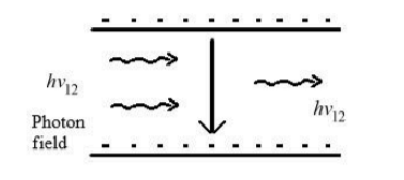
In a LASER device the instantaneous populations of energy $E_1$ and $E_2$ (figure below) to be $n_1$ and $n_2$ respectively. At thermal equilibrium the relative population is given by $n_2 = n_1e^{-h\nu_{12}/KT}$
The condition for population inversion when stimulated emission dominates is given by
The following are correct about a semiconductor LASER :
1. It requires population inversion
2. It has shorter lifetime than LED
3. It demonstrates spontaneous emission phenomenon
4. It generates monochromatic incoherent light.Find out the correct answer :
In comparison to LED, LASER has
1. high emission frequency
2. no tuning arrangement
3. narrow spectral bandwidth
4. provision for confinement



