
Which of the following conditions is applicable in semiconductor LASERs ?
EFC - EFV > Eg
To determine the condition applicable in semiconductor lasers, let's examine the given options in the context of electronic devices, specifically focusing on semiconductor physics.
Semiconductor lasers, also known as laser diodes, rely on the principle of stimulated emission to produce coherent light. To achieve this, a population inversion is required, which occurs when the number of electrons in the conduction band exceeds those in the valence band. Let's dissect this mechanism:
- Population Inversion: To create a population inversion, the separation between the quasi-Fermi levels, \(E_{FC}\) (quasi-Fermi level for the conduction band) and \(E_{FV}\) (quasi-Fermi level for the valence band), must exceed the bandgap energy \(E_{g}\).
- Condition: The condition \(E_{FC} - E_{FV} > E_{g}\) is critical because it ensures that the electrons have enough energy to occupy the conduction band states above the valence band states, creating the necessary population inversion.
- Analyzing the given options:
- \(E_{FC} - E_{FV} = E_{g}\): This condition does not ensure a population inversion; the energy difference is just equal to the bandgap.
- \(E_{FC} - E_{FV} > E_{g}\): This is the correct condition needed for a semiconductor laser to operate, as it ensures the population inversion.
- \(E_{FC} - E_{FV} < E_{g}\): This condition means the energy difference is less than the bandgap, which cannot support population inversion.
- \(E_{FC} - E_{FV} = 2E_{g}\): This condition is not standard or necessary for the functioning of semiconductor lasers.
- Therefore, the condition \(E_{FC} - E_{FV} > E_{g}\) is necessary for achieving population inversion, which is essential for the operation of semiconductor lasers.
Conclusion: The correct answer is the condition where the energy difference between the quasi-Fermi levels is greater than the bandgap energy, which is \(E_{FC} - E_{FV} > E_{g}\).
Similar Questions
The following are correct about a semiconductor LASER :
1. It requires population inversion
2. It has shorter lifetime than LED
3. It demonstrates spontaneous emission phenomenon
4. It generates monochromatic incoherent light.Find out the correct answer :
In comparison to LED, LASER has
1. high emission frequency
2. no tuning arrangement
3. narrow spectral bandwidth
4. provision for confinementWhich of the following statements are incorrect in case of semiconductor LASERs ?
(a) Stimulated emission rate dominates the spontaneous emission with increase in the value of energy of radiation per unit volume per unit frequency.
(b) Stimulated emission rate dominates the absorption rate of the charge carriers in the ground state are higher than the excited state.
(c) LASERs have a longer life-line than LEDs.
(d) LASER diodes are more temperature sensitive than LEDs.
Options :
Consider the following Excimer Lasers used for photolithography and surgery purposes :
1. Ar2 Excimer laser
2. ArF Excimer laser
3. XeCl Excimer laser
4. XeF Excimer laserThe correct sequence of the descending order of wavelength of operation is
Important Questions from Laser
The following is not a candidate material for Laser source in Fiber Optics
What is a DISADVANTAGE of LED lights over LASER lights?
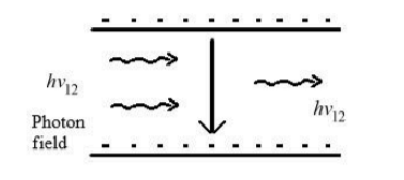
In a LASER device the instantaneous populations of energy $E_1$ and $E_2$ (figure below) to be $n_1$ and $n_2$ respectively. At thermal equilibrium the relative population is given by $n_2 = n_1e^{-h\nu_{12}/KT}$
The condition for population inversion when stimulated emission dominates is given by
The following are correct about a semiconductor LASER :
1. It requires population inversion
2. It has shorter lifetime than LED
3. It demonstrates spontaneous emission phenomenon
4. It generates monochromatic incoherent light.Find out the correct answer :
In comparison to LED, LASER has
1. high emission frequency
2. no tuning arrangement
3. narrow spectral bandwidth
4. provision for confinement



