
Read the passage and answer the questions that follow on your understanding of the passage : Optical fibre communication is one among the new techniques have come up and are extensively used for communication purposes. The portion of the e.m. spectrum encompasses the optical region falls in the wavelength of 50 nm (Ultraviolet) to approximately 100 µm (Infrared) which includes visible light spectrum from 400 nm (Violet) to 700 nm (Red). The order of frequency corresponding to these wavelengths falls in the range 1014 to 1018 Hz. There are two types of transmission media used for optical communication i.e., atmospheric channel and guided wave channel. Out of the two, guided wave channel provide much more reliable and versatile medium of communication. The medium used for guided channels in optical range are non-metallic guides popularly known as optical fibre. The optical fibre link used for communication applications has several advantages over conventional copper cable links which makes possible to send much more data over long distances with negligible attenuation. Although some difficulties do exist in the making of optical fibre set and there are some challenges being faced yet this type of communication mechanism has made a great impact in the present scenario.
The following are correct about a semiconductor LASER : 1. It requires population inversion Find out the correct answer :
2. It has shorter lifetime than LED
3. It demonstrates spontaneous emission phenomenon
4. It generates monochromatic incoherent light.
1 & 2
Statements 3 and 4 each contradict what a laser is, which leaves 1 and 2 — option 1.
| Statement | Verdict |
|---|---|
| 1. Requires population inversion | ✓ The precondition for lasing |
| 2. Shorter lifetime than an LED | ✓ Operationally, yes |
| 3. Spontaneous emission | ✗ Lasing is stimulated emission |
| 4. Monochromatic incoherent | ✗ Laser light is coherent |
Statement 3 names the wrong process, and the acronym itself refutes it : LASER stands for Light Amplification by Stimulated Emission of Radiation. Spontaneous emission does occur in the device — indeed it starts the process, and below threshold a laser diode behaves as a rather poor LED — but what defines lasing is stimulated emission, in which an incident photon triggers an identical one, matched in phase, direction, polarisation and frequency.
Statement 4 confuses two independent properties. Monochromatic means a narrow spread of wavelengths; coherent means a fixed phase relationship across the beam. Laser light is both, and it is coherent precisely because stimulated emission copies the phase of the triggering photon. An LED is neither — its spontaneous emission gives random phases and a 30 to 50 nm spread.
Statement 1 — why inversion is needed. An incident photon can either be absorbed by an electron in the lower state or stimulate emission from one in the upper state. Net amplification therefore requires more population above than below — a population inversion, which is not an equilibrium condition and must be maintained by pumping. In a semiconductor laser this means heavy forward bias across a degenerately doped junction, driving carriers in faster than they recombine, and the device lases only above a threshold current.
Statement 2 — the lifetime claim, and why the answer is flagged. Laser diodes are operationally shorter-lived than LEDs, typically \(10^{4}\) to \(10^{5}\) hours against an LED's \(10^{6}\). They run at far higher current density and optical power, so facet damage, dark-line defect growth and thermal ageing accumulate faster. The statement is nevertheless ambiguous — "lifetime" could also be read as carrier recombination lifetime, which is likewise shorter in a laser, since stimulated emission depletes the upper state much faster than spontaneous emission. Both readings support the statement, and no other option is defensible.
Hence, statements 1 and 2 are correct.
Similar Questions
In comparison to LED, LASER has
1. high emission frequency
2. no tuning arrangement
3. narrow spectral bandwidth
4. provision for confinementWhich of the following conditions is applicable in semiconductor LASERs ?
Which of the following statements are incorrect in case of semiconductor LASERs ?
(a) Stimulated emission rate dominates the spontaneous emission with increase in the value of energy of radiation per unit volume per unit frequency.
(b) Stimulated emission rate dominates the absorption rate of the charge carriers in the ground state are higher than the excited state.
(c) LASERs have a longer life-line than LEDs.
(d) LASER diodes are more temperature sensitive than LEDs.
Options :
Consider the following Excimer Lasers used for photolithography and surgery purposes :
1. Ar2 Excimer laser
2. ArF Excimer laser
3. XeCl Excimer laser
4. XeF Excimer laserThe correct sequence of the descending order of wavelength of operation is
Important Questions from Laser
The following is not a candidate material for Laser source in Fiber Optics
What is a DISADVANTAGE of LED lights over LASER lights?
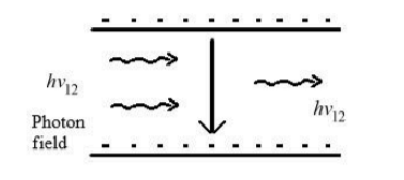
In a LASER device the instantaneous populations of energy $E_1$ and $E_2$ (figure below) to be $n_1$ and $n_2$ respectively. At thermal equilibrium the relative population is given by $n_2 = n_1e^{-h\nu_{12}/KT}$
The condition for population inversion when stimulated emission dominates is given by
In comparison to LED, LASER has
1. high emission frequency
2. no tuning arrangement
3. narrow spectral bandwidth
4. provision for confinementWhich of the following conditions is applicable in semiconductor LASERs ?



