
In comparison to LED, LASER has 1. high emission frequency
2. no tuning arrangement
3. narrow spectral bandwidth
4. provision for confinement
1, 3 and 4 are correct.
Statement 2 is the false one — a laser diode is defined by having a resonant cavity, which is precisely a tuning arrangement — so the correct set is 1, 3 and 4, option 1.
| Statement | Verdict |
|---|---|
| 1. High emission frequency | ✓ Threshold pushes it into the higher-energy region |
| 2. No tuning arrangement | ✗ The cavity is exactly that |
| 3. Narrow spectral bandwidth | ✓ Under 1 nm against 30–50 nm |
| 4. Provision for confinement | ✓ Both optical and carrier confinement |
Why statement 2 fails. An LED emits spontaneously in every direction, with nothing to select a wavelength. A laser diode adds a Fabry-Perot cavity — two cleaved, partially reflecting facets — which supports only those wavelengths satisfying
\(m\lambda=2nL\)
The cavity length therefore selects the emitted wavelength, and distributed-feedback lasers refine the same idea with a grating etched along the waveguide to leave a single mode standing. Far from having no tuning arrangement, the laser is the only one of the two that possesses one.
Statement 4 is the same feature seen from another side, and is central to how the device works. Reaching threshold requires a high carrier density and a high optical intensity in the same small volume, which needs two kinds of confinement at once: a double heterostructure sandwiches a narrow-gap active layer between wider-gap cladding, whose energy barriers trap the injected carriers, while the same layers' higher refractive index in the middle forms a waveguide that traps the light. Stripe geometry confines both laterally. An LED needs none of this and has none of it.
Statement 3 follows from the cavity: stimulated emission copies the phase and wavelength of the triggering photon, and the cavity discards everything off-resonance, so the linewidth collapses from tens of nanometres to a fraction of one — which is what makes lasers essential for long-haul fibre, where chromatic dispersion scales directly with source linewidth.
Flagged because statement 1 is loosely worded: emission frequency is set by the material's band gap, and both devices can be made from the same material. It is true in the sense that a laser's threshold condition favours transitions at the higher-energy end of the gain spectrum, and it is the only remaining statement, so the set is 1, 3, 4.
Hence, statements 1, 3 and 4 are correct.
Similar Questions
The following are correct about a semiconductor LASER :
1. It requires population inversion
2. It has shorter lifetime than LED
3. It demonstrates spontaneous emission phenomenon
4. It generates monochromatic incoherent light.Find out the correct answer :
Which of the following conditions is applicable in semiconductor LASERs ?
Which of the following statements are incorrect in case of semiconductor LASERs ?
(a) Stimulated emission rate dominates the spontaneous emission with increase in the value of energy of radiation per unit volume per unit frequency.
(b) Stimulated emission rate dominates the absorption rate of the charge carriers in the ground state are higher than the excited state.
(c) LASERs have a longer life-line than LEDs.
(d) LASER diodes are more temperature sensitive than LEDs.
Options :
Consider the following Excimer Lasers used for photolithography and surgery purposes :
1. Ar2 Excimer laser
2. ArF Excimer laser
3. XeCl Excimer laser
4. XeF Excimer laserThe correct sequence of the descending order of wavelength of operation is
Important Questions from Laser
The following is not a candidate material for Laser source in Fiber Optics
What is a DISADVANTAGE of LED lights over LASER lights?
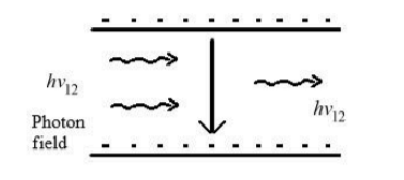
In a LASER device the instantaneous populations of energy $E_1$ and $E_2$ (figure below) to be $n_1$ and $n_2$ respectively. At thermal equilibrium the relative population is given by $n_2 = n_1e^{-h\nu_{12}/KT}$
The condition for population inversion when stimulated emission dominates is given by
The following are correct about a semiconductor LASER :
1. It requires population inversion
2. It has shorter lifetime than LED
3. It demonstrates spontaneous emission phenomenon
4. It generates monochromatic incoherent light.Find out the correct answer :
Which of the following conditions is applicable in semiconductor LASERs ?



