
Consider the following Excimer Lasers used for photolithography and surgery purposes : 1. Ar2 Excimer laser The correct sequence of the descending order of wavelength of operation is
2. ArF Excimer laser
3. XeCl Excimer laser
4. XeF Excimer laser
4, 3, 2, 1
Excimer wavelengths are standard figures, and they happen to run in the reverse of the order the question lists them.
| Excimer | Wavelength | Photon energy | Typical use |
|---|---|---|---|
| XeF | 351 nm | 3.5 eV | Dye-laser pumping, marking |
| XeCl | 308 nm | 4.0 eV | Dermatology, laser angioplasty |
| ArF | 193 nm | 6.4 eV | Photolithography, LASIK surgery |
| Ar2 | 126 nm | 9.8 eV | Vacuum-UV research |
Descending wavelength is therefore XeF, XeCl, ArF, Ar2 — that is 4, 3, 2, 1, option 4. The list as printed is in ascending order, so the answer is simply that list reversed, which is the quickest way to see it.
The pattern behind the numbers. The halogen fixes the wavelength far more than the noble gas: fluorides sit at shorter wavelengths than chlorides for a given noble gas only when the noble gas is lighter, and the rare-gas dimer Ar2, with no halogen at all, is shortest of the four. Practically, remembering the two workhorses — ArF at 193 nm and KrF at 248 nm — anchors the rest.
What an excimer actually is. The name contracts "excited dimer": the molecule exists only in the excited state. Its ground state is unbound, so as soon as the molecule emits a photon it falls apart into free atoms. That gives the perfect population inversion — the lower laser level empties itself instantly and can never fill up — which is why excimer lasers are so efficient in the ultraviolet, where conventional four-level schemes struggle.
Why 193 nm matters so much in electronics. Photolithographic resolution follows
\(R=k_{1}\dfrac{\lambda}{NA}\)
so the industry's move from 365 nm (mercury i-line) to 248 nm (KrF) to 193 nm (ArF) bought each successive generation of finer feature sizes; immersion lithography then extended 193 nm well below its nominal limit.
And why the same wavelength suits surgery : a 6.4 eV photon exceeds the binding energy of carbon-carbon bonds, so tissue is removed by direct photo-ablation rather than by heating — a clean cut with almost no thermal damage to the surrounding material, which is exactly what corneal reshaping requires.
Hence, the descending order of wavelength is 4, 3, 2, 1.
Similar Questions
The following are correct about a semiconductor LASER :
1. It requires population inversion
2. It has shorter lifetime than LED
3. It demonstrates spontaneous emission phenomenon
4. It generates monochromatic incoherent light.Find out the correct answer :
In comparison to LED, LASER has
1. high emission frequency
2. no tuning arrangement
3. narrow spectral bandwidth
4. provision for confinementWhich of the following conditions is applicable in semiconductor LASERs ?
Which of the following statements are incorrect in case of semiconductor LASERs ?
(a) Stimulated emission rate dominates the spontaneous emission with increase in the value of energy of radiation per unit volume per unit frequency.
(b) Stimulated emission rate dominates the absorption rate of the charge carriers in the ground state are higher than the excited state.
(c) LASERs have a longer life-line than LEDs.
(d) LASER diodes are more temperature sensitive than LEDs.
Options :
Important Questions from Laser
The following is not a candidate material for Laser source in Fiber Optics
What is a DISADVANTAGE of LED lights over LASER lights?
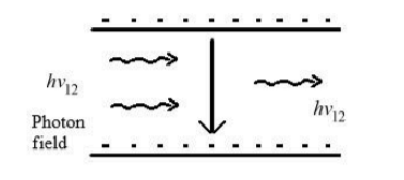
In a LASER device the instantaneous populations of energy $E_1$ and $E_2$ (figure below) to be $n_1$ and $n_2$ respectively. At thermal equilibrium the relative population is given by $n_2 = n_1e^{-h\nu_{12}/KT}$
The condition for population inversion when stimulated emission dominates is given by
The following are correct about a semiconductor LASER :
1. It requires population inversion
2. It has shorter lifetime than LED
3. It demonstrates spontaneous emission phenomenon
4. It generates monochromatic incoherent light.Find out the correct answer :
In comparison to LED, LASER has
1. high emission frequency
2. no tuning arrangement
3. narrow spectral bandwidth
4. provision for confinement



