
In a LASER device the instantaneous populations of energy $E_1$ and $E_2$ (figure below) to be $n_1$ and $n_2$ respectively. At thermal equilibrium the relative population is given by $n_2 = n_1e^{-h\nu_{12}/KT}$ The condition for population inversion when stimulated emission dominates is given by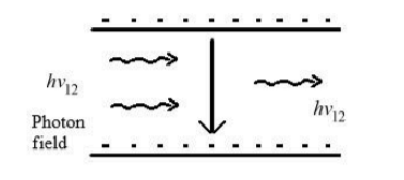
To answer this question, let's first understand the concept of population inversion in a laser device.
In laser physics, population inversion is a condition where the number of particles in an excited energy state is greater than the number of particles in a lower energy state. This is essential for achieving stimulated emission over absorption, which is critical for laser operation.
Given that at thermal equilibrium, the relative population is represented as: \(n_2 = n_1 e^{-h\nu_{12}/kT}\),
Here:
- \(n_1\) and \(n_2\) are the population of the lower and upper energy states respectively.
- \(h\nu_{12}\) represents the energy difference between the two states.
- \(k\) is the Boltzmann constant.
- \(T\) is the temperature.
For population inversion, we need \(n_2 > n_1\), meaning the population of the higher energy state must be greater than that of the lower energy state. This condition allows the stimulated emission to dominate, which is necessary for laser action.
Let's evaluate the given options based on this information:
\(n_2 = n_1\)
- : This implies equilibrium population, not inversion.
\(n_2 < n_1\)
- : This indicates that absorption would dominate, not suitable for laser operation.
\(n_2 > n_1\)
- : This is the required condition for population inversion and hence is the correct condition for lasing action.
None of the above
- : Incorrect as we have identified the correct condition.
Thus, the correct answer is \(n_2 > n_1\), ensuring stimulated emission dominates over absorption.
Important Questions from Laser
The following is not a candidate material for Laser source in Fiber Optics
What is a DISADVANTAGE of LED lights over LASER lights?
The following are correct about a semiconductor LASER :
1. It requires population inversion
2. It has shorter lifetime than LED
3. It demonstrates spontaneous emission phenomenon
4. It generates monochromatic incoherent light.Find out the correct answer :
In comparison to LED, LASER has
1. high emission frequency
2. no tuning arrangement
3. narrow spectral bandwidth
4. provision for confinementWhich of the following conditions is applicable in semiconductor LASERs ?


