
Which of the following gauge is used to determine the pitch of a thread?
Screw Pitch Gauge
Understanding Thread Pitch Measurement
Determining the pitch of a thread is a crucial step in ensuring proper fastening and fit between threaded components. The pitch of a thread is defined as the distance between corresponding points on adjacent thread forms, measured parallel to the axis.
Identifying the Correct Gauge
Various measuring tools are available for different purposes in mechanical and manufacturing contexts. The question asks for the specific gauge used to measure the pitch of a thread. Let's examine the options provided:
- Feeler Gauge: A feeler gauge is a tool used to measure gap widths or clearances between parts. It consists of a set of metal blades of different thicknesses, each marked with its size. It is not used for measuring thread pitch.
- Radius Gauge: A radius gauge is used to measure the radius of a curve, typically on external or internal fillets and rounds. It helps in checking if the curve matches a specific radius. It is not used for measuring thread pitch.
- Screw Pitch Gauge: A screw pitch gauge is a tool specifically designed to measure the pitch or lead of a screw thread. It consists of a series of blades, each with teeth corresponding to a specific thread profile and pitch. By holding the gauge blade against the thread, one can find the blade that fits perfectly into the thread grooves, thereby identifying the thread pitch. This gauge is specifically designed for this purpose.
- Plus Gauge: 'Plus Gauge' is not a standard term for a common measuring gauge related to threads or general dimensions in the way the other options are. It is likely not a relevant tool for measuring thread pitch.
Based on the intended use of each gauge, the tool specifically designed for determining the pitch of a thread is the Screw Pitch Gauge.
How a Screw Pitch Gauge Works
A screw pitch gauge contains multiple leaves, each precisely manufactured with the profile of a specific standard thread pitch (e.g., metric pitches like 0.5 mm, 0.75 mm, 1 mm, or imperial pitches like 20 TPI, 16 TPI, 14 TPI). To use it:
- Select a leaf that you suspect might match the thread pitch.
- Hold the edge of the leaf against the thread, aligning the teeth with the thread grooves.
- If the leaf fits snugly without any gap or wobble, and the teeth align perfectly along the thread's length, then the pitch of the thread matches the pitch marked on that leaf.
- Try different leaves until the correct fit is found.
This simple tool provides a quick and effective way to identify the standard pitch of a thread.
Conclusion
Among the given options, the Screw Pitch Gauge is the correct tool used to determine the pitch of a thread.
Revision Table: Understanding Different Gauges
| Gauge Type | Primary Function | Used for Thread Pitch? |
|---|---|---|
| Feeler Gauge | Measuring gaps or clearances | No |
| Radius Gauge | Measuring the radius of curves | No |
| Screw Pitch Gauge | Measuring the pitch/lead of threads | Yes |
| Plus Gauge | (Not a standard widely known gauge for this purpose) | No |
Additional Information on Thread Measurement Tools
While the screw pitch gauge is used for a quick identification of standard pitches, other tools can provide more precise measurements related to threads:
- Thread Micrometer: This tool is used to measure the pitch diameter of a thread accurately. It has a pointed spindle and a V-shaped anvil that fit into the thread grooves.
- Optical Comparator (Profile Projector): This instrument can project a magnified profile of the thread onto a screen, allowing for detailed measurement of various thread elements, including pitch, angle, and form.
- Coordinate Measuring Machine (CMM): A CMM can measure thread geometry with very high precision using touch probes or scanning technology.
Each tool serves a different purpose in the comprehensive inspection and measurement of threads, from simple identification to high-precision dimensional analysis.
Similar Questions
When cutting an ISO Metric thread for a coarse pitch, by how many degrees should the compound rest be swiveled to?
Taps are re-sharpened by grinding:
The type of thread used in lead screw of a lathe is ______
The surface connecting crest and root of a thread is termed as
Angle of Knuckle thread is ______
Which one of the following is used to rectify damaged or rusted threads?
The resistance of fine thread unscrewing is ______
Lead is equal to double the pitch value then this type of thread is called as _____.
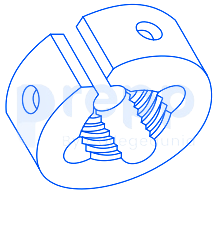
Identify the type of Die in the above Fig.
- The distance from a point on a thread to the corresponding point on the next thread of a screw is called ______.
Important Questions from Screw Threads
When cutting an ISO Metric thread for a coarse pitch, by how many degrees should the compound rest be swiveled to?
What is the blank size (diameter) for preparing a bolt of M12 × 1.5?
What is the relation between the lead (L) and pitch (P) of a two-start thread screw?
Taps are re-sharpened by grinding:
The form of thread in a saw tooth thread is



