
The work to be done to increase the speed of a 0.5 kg ball from 4 m/s to 8 m/s is:
12 J
CONCEPT:
Work done:
It is the dot product of Force and Displacement .
Work Done (W) = Force (F) × Displacement (S)
Kinetic energy:
The energy of a particle due to its velocity is called kinetic energy.
It is denoted by K.E.
\(K.E=\frac{1}{2}mV^2\)
where m = mass of the particle and V = velocity of the particle.
Work energy theorem :
The work done by all the forces on a system is equal to change in kinetic energy of the system.
Work done by all the forces (W) = Final K.E – Initial K.E
CALCULATION:
Given that:
Initial velocity (u) = 4 m/s, final velocity (v) = 8 m/s and
Mass (m) = 0.5 kg
Applying the work-energy theorem:
Work done = Change in Kinetic Energy:
ΔK.E = (K.E) 2- (K.E) 1
\(\Rightarrow \frac{1}{2}m(v^2-u^2)\)
\(\Rightarrow \frac{1}{2}\times\;0.5\times(8^2-4^2)\)
∴ ΔK.E is 12 J
Similar Questions
- What force (effort) will be required to push a load, initially at rest, of mass 500 g, so that at a distance of 20 m, its final velocity is 20 m/sec [Assume that there is no friction and 'g' = 10 m/s²].
An Odometer is an instrument used to measure ________ in automobiles.
The tendency of undisturbed objects to stay at rest or to keep moving with the same velocity is called _______.
An object is accelerating at 5 m/s2 from its rest position. The velocity of this object after 5 s is:
Important Questions from Newton's Laws of Motion
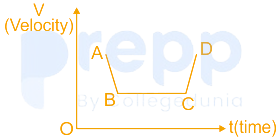
In the given velocity (V) versus time (t) graph, accelerated and decelerated motions are respectively represented by line segments
A balloon is filled with air. The mass of the air in the balloon is 10 gram. A small hole is made to the balloon and released. The balloon moves up with an average speed of 5 cm/s and shrinks completely in 5 seconds. Find the average force acting on the balloon.
A uniform rope is suspended from the roof of a building. The rope breaks if the tension in the rope is greater than 700 N.
A man of mass 50 kg climbs up the rope. Find the maximum acceleration with which he can climb up the rope (g = 10 m/s2)A ball is thrown up with a certain velocity, it attains 50 m and come back to the thrower then the
A string of certain length used to whirl a stone in a vertical circle with certain velocity. The tension developed in the string will be



