
An object is accelerating at 5 m/s2 from its rest position. The velocity of this object after 5 s is:
25 m/s
Calculating Final Velocity with Constant Acceleration
The question asks us to find the velocity of an object after a specific time, given its initial state (at rest) and its constant acceleration.
We are provided with the following information:
- Initial velocity (\(u\)) = 0 m/s (since the object starts from rest)
- Acceleration (\(a\)) = 5 m/s²
- Time (\(t\)) = 5 s
We need to find the final velocity (\(v\)) of the object after 5 seconds.
To solve this problem, we can use the first equation of motion (kinematic equation), which relates initial velocity, final velocity, acceleration, and time for objects moving with constant acceleration:
\(v = u + at\)
Where:
- \(v\) is the final velocity
- \(u\) is the initial velocity
- \(a\) is the acceleration
- \(t\) is the time taken
Now, we substitute the given values into the equation:
\(v = 0 \text{ m/s} + (5 \text{ m/s}^2)(5 \text{ s})\)
Performing the multiplication:
\(v = 0 \text{ m/s} + 25 \text{ m/s}\)
Calculating the final velocity:
\(v = 25 \text{ m/s}\)
Thus, the velocity of the object after 5 seconds is 25 m/s.
Let's compare this result with the given options:
| Option | Velocity | Matches our result? |
|---|---|---|
| 1 | 15 m/s | No |
| 2 | 20 m/s | No |
| 3 | 5 m/s | No |
| 4 | 25 m/s | Yes |
The calculated velocity of 25 m/s matches Option 4.
Revision Table: Kinematic Equations Summary
Here are the primary kinematic equations used for motion with constant acceleration:
| Equation | Variables Involved | When to Use |
|---|---|---|
| \(v = u + at\) | v, u, a, t | To find final velocity (v) or time (t) when displacement is not involved. |
| \(s = ut + \frac{1}{2}at^2\) | s, u, a, t | To find displacement (s) or time (t) when final velocity is not involved. |
| \(v^2 = u^2 + 2as\) | v, u, a, s | To find final velocity (v) or displacement (s) when time is not involved. |
| \(s = \frac{(u+v)t}{2}\) | s, u, v, t | To find displacement (s) or time (t) when acceleration is not involved. |
In these equations:
- \(s\) is the displacement
- \(u\) is the initial velocity
- \(v\) is the final velocity
- \(a\) is the acceleration
- \(t\) is the time
Additional Information: Understanding Acceleration
Acceleration is defined as the rate of change of velocity of an object. It is a vector quantity, meaning it has both magnitude and direction. The unit of acceleration is meters per second squared (\(m/s^2\)) in the SI system.
- When an object's velocity is increasing, its acceleration is in the same direction as its velocity. This is often called positive acceleration or simply acceleration.
- When an object's velocity is decreasing (slowing down), its acceleration is in the opposite direction to its velocity. This is often called negative acceleration or deceleration/retardation.
- If an object has zero acceleration, its velocity remains constant. If the object is moving, it continues to move at a constant speed in a straight line. If it is at rest, it remains at rest.
In this problem, the object has a constant positive acceleration of 5 m/s², meaning its velocity increases by 5 m/s every second in the direction of motion.
Similar Questions
- What force (effort) will be required to push a load, initially at rest, of mass 500 g, so that at a distance of 20 m, its final velocity is 20 m/sec [Assume that there is no friction and 'g' = 10 m/s²].
An Odometer is an instrument used to measure ________ in automobiles.
The tendency of undisturbed objects to stay at rest or to keep moving with the same velocity is called _______.
The work to be done to increase the speed of a 0.5 kg ball from 4 m/s to 8 m/s is:
Important Questions from Newton's Laws of Motion
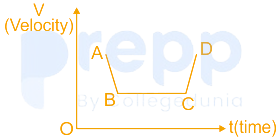
In the given velocity (V) versus time (t) graph, accelerated and decelerated motions are respectively represented by line segments
A balloon is filled with air. The mass of the air in the balloon is 10 gram. A small hole is made to the balloon and released. The balloon moves up with an average speed of 5 cm/s and shrinks completely in 5 seconds. Find the average force acting on the balloon.
A uniform rope is suspended from the roof of a building. The rope breaks if the tension in the rope is greater than 700 N.
A man of mass 50 kg climbs up the rope. Find the maximum acceleration with which he can climb up the rope (g = 10 m/s2)A ball is thrown up with a certain velocity, it attains 50 m and come back to the thrower then the
A string of certain length used to whirl a stone in a vertical circle with certain velocity. The tension developed in the string will be



