
The tendency of undisturbed objects to stay at rest or to keep moving with the same velocity is called _______.
Inertia
Understanding Inertia and Object Tendency
The question asks about the fundamental property of objects that describes their resistance to changes in their state of motion. This state of motion can be either being at rest or moving with a constant velocity (speed and direction). The tendency of undisturbed objects to maintain this state is a key concept in physics.
Identifying the Correct Concept: Inertia
Let's examine the given options to determine which one accurately describes this tendency:
- Force: A force is an interaction that can cause a change in an object's motion. It is what overcomes the tendency to stay in the current state, not the tendency itself.
- Inertia: Inertia is precisely the property of an object that resists changes in its state of motion. An object at rest tends to stay at rest, and an object in motion tends to stay in motion with the same velocity, unless acted upon by an external force. This is a direct definition of inertia.
- Momentum: Momentum is a measure of the mass and velocity of an object (\(\text{momentum} = \text{mass} \times \text{velocity}\)). While related to motion, it quantifies the 'quantity of motion' rather than the resistance to changes in motion.
- Energy: Energy is the capacity to do work. It exists in various forms (like kinetic energy, potential energy) and is associated with an object's state or position, but it is not the property that describes the tendency to resist changes in motion.
Based on the definitions, the tendency of undisturbed objects to stay at rest or keep moving with the same velocity is called inertia. This concept is famously described by Newton's first law of motion, also known as the law of inertia.
Newton's First Law of Motion (Law of Inertia)
Newton's first law states that an object will remain at rest or in uniform motion in a straight line unless acted upon by an external force. This law directly reflects the concept of inertia. The greater an object's mass, the greater its inertia, meaning it is harder to change its state of motion.
Therefore, the term that correctly fills the blank is Inertia.
Revision Table: Key Physics Concepts
| Concept | Description | Role in Motion |
|---|---|---|
| Inertia | Tendency to resist changes in state of motion (rest or constant velocity). Proportional to mass. | Explains why objects need a force to start moving, stop moving, or change direction. |
| Force | A push or pull; interaction that can change an object's motion. | Causes acceleration (change in velocity). |
| Momentum | Product of mass and velocity (\(p = mv\)). | Measure of motion; conserved in absence of external forces. |
| Energy | Capacity to do work. | Exists in various forms (kinetic, potential, etc.); can be transferred or transformed. |
Additional Information on Inertia
Inertia is a scalar quantity and is directly related to mass. The more mass an object has, the more inertia it possesses, and thus the more difficult it is to change its velocity. Inertia is fundamental to understanding how objects behave when forces are applied.
We often encounter inertia in everyday life:
- When a car suddenly stops, passengers tend to keep moving forward due to their inertia.
- Pushing a heavy box requires more force than pushing a light box because the heavy box has greater inertia.
- It is difficult to change the direction of a fast-moving train due to its large mass and high inertia.
Understanding inertia helps us understand the relationship between force and motion, which is further elaborated in Newton's second and third laws of motion.
Similar Questions
- What force (effort) will be required to push a load, initially at rest, of mass 500 g, so that at a distance of 20 m, its final velocity is 20 m/sec [Assume that there is no friction and 'g' = 10 m/s²].
An Odometer is an instrument used to measure ________ in automobiles.
The work to be done to increase the speed of a 0.5 kg ball from 4 m/s to 8 m/s is:
An object is accelerating at 5 m/s2 from its rest position. The velocity of this object after 5 s is:
Important Questions from Newton's Laws of Motion
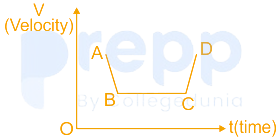
In the given velocity (V) versus time (t) graph, accelerated and decelerated motions are respectively represented by line segments
A balloon is filled with air. The mass of the air in the balloon is 10 gram. A small hole is made to the balloon and released. The balloon moves up with an average speed of 5 cm/s and shrinks completely in 5 seconds. Find the average force acting on the balloon.
A uniform rope is suspended from the roof of a building. The rope breaks if the tension in the rope is greater than 700 N.
A man of mass 50 kg climbs up the rope. Find the maximum acceleration with which he can climb up the rope (g = 10 m/s2)A ball is thrown up with a certain velocity, it attains 50 m and come back to the thrower then the
A string of certain length used to whirl a stone in a vertical circle with certain velocity. The tension developed in the string will be



