Thermal Expansion Volume Increase Calculation
This problem asks for the approximate increase in the volume of a metallic sphere when its temperature increases.
Key Concepts
- The initial volume ($V_0$) of a sphere with radius $R$ is given by the formula $V_0 = \frac{4}{3}\pi R^3$.
- The linear coefficient of thermal expansion is $\alpha$.
- For isotropic materials like metals, the volume expansion coefficient ($\beta$) is approximately three times the linear expansion coefficient: $\beta \approx 3\alpha$.
- The change in volume ($\Delta V$) due to a temperature change ($\Delta T$) is calculated as $\Delta V = V_0 \beta \Delta T$.
Volume Increase Calculation
- Initial Volume: Calculate the initial volume of the sphere:
$ V_0 = \frac{4}{3}\pi R^3 $
- Volume Expansion Coefficient: Determine the volume expansion coefficient:
$ \beta \approx 3\alpha $
- Change in Volume: Apply the formula for volume expansion:
$ \Delta V = V_0 \beta \Delta T $
Substitute the expressions for $V_0$ and $\beta$:$ \Delta V = \left(\frac{4}{3}\pi R^3\right) (3\alpha) (\Delta T) $
Simplify the expression:$ \Delta V = 4\pi R^3 \alpha \Delta T $
Conclusion
The approximate increase in the volume of the sphere is $4\pi R^3 \alpha \Delta T$. This corresponds to Option B.
Similar Questions
- A submarine is designed to withstand an absolute pressure of $100 \text{ atm}$. How deep can it go below the water surface?
(Consider the density of water = $1000 \text{ kg m}^{-3}$, $1 \text{ atm} = 1 \times 10^5 \text{ Pa}$ and gravitational acceleration $g = 10 \text{ m/s}^2$) Match List I with List II :
List I List II A. Young's Modulus I. $\frac{\Delta d}{\Delta L} ( \frac{L}{d})$ B. Compressibility II. $\frac{FL}{A(\Delta L)}$ C. Bulk Modulus III. $-\frac{1}{\Delta P} (\frac{\Delta V}{V})$ D. Poisson's Ratio IV. $-P(\frac{V}{\Delta V})$
Choose the correct answer from the options given below :- In the measurement of viscosity of liquids using terminal velocity experiment, spherical balls of same radius but having different densities are used. The variation of the terminal velocity ($v$) with the ratio of density of spherical ball ($\sigma$) to density of the liquid ($\rho$), is best represented by :
Water flows in a streamline motion through a horizontal pipe of circular cross-section as shown in the figure. The pressure difference of water between P and Q is $15\text{ Nm}^{-2}$. The area of cross-section at P and Q are $40\text{ cm}^2$ and $20\text{ cm}^2$, respectively. The rate of flow of water through the pipe, in $\text{cm}^3\text{s}^{-1}$, is :
[Take density of water $= 1000\text{ kg m}^{-3}$]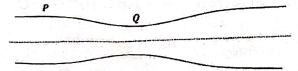
Important Questions from Physical and Thermal Properties of Bulk Matter
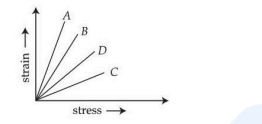
The strain-stress plot for materials $A, B, C$ and $D$ is shown in the figure. Which material has the largest Young's modulus ?
- Eight mercury drops, each of radius $r$, coalesce to form a bigger drop. The surface energy released in this process is ___________. ($\text{S}$ is the surface tension of mercury).
- An ideal gas at pressure $P$ and temperature $T$ is expanding such that $P T^{3} = \text{constant}$. The coefficient of volume expansion of the gas is ___________.
- The surface tension of a soap solution is $3.5 \times 10^{-2}~\text{N/m}$. The work required to increase the radius of a soap bubble from $1~\text{cm}$ to $2~\text{cm}$ is $\alpha \times 10^{-6}~\text{J}$. The value of $\alpha$ is________.
($\pi = 22/7$) - The temperature of a metal strip having coefficient of linear expansion $\alpha$ is increased from $T_1$ to $T_2$ resulting in increase of its length by $\Delta L_1$. The temperature is further increased from $T_2$ to $T_3$ such that the increase in its length is $\Delta L_2$.
Given $T_3 + T_1 = 2T_2$ and $T_2 - T_1 = \Delta T$, the value of $\Delta L_2$ is _______.