
To find the surface energy released when eight mercury drops coalesce, we need to compare the initial total surface area of the small drops with the final surface area of the large drop.
Calculating Initial Surface Area
The surface area of a single spherical drop with radius r is given by the formula $A_{small} = 4 \pi r^2$.
There are eight such drops. So, the total initial surface area is:
$ A_{initial} = 8 \times A_{small} = 8 \times (4 \pi r^2) = 32 \pi r^2 $
Calculating Final Surface Area
Let the radius of the larger, combined drop be R. The volume is conserved during coalescence.
The volume of one small drop is $V_{small} = \frac{4}{3} \pi r^3$.
The total volume of the eight small drops is:
$ V_{total\_small} = 8 \times V_{small} = 8 \times \frac{4}{3} \pi r^3 $
The volume of the single large drop is $V_{large} = \frac{4}{3} \pi R^3$.
Equating the volumes:
$ \frac{4}{3} \pi R^3 = 8 \times \frac{4}{3} \pi r^3 $
Simplifying this equation gives:
$ R^3 = 8 r^3 $
Taking the cube root of both sides:
$ R = 2r $
Now, calculate the surface area of this larger drop:
$ A_{final} = 4 \pi R^2 = 4 \pi (2r)^2 = 4 \pi (4r^2) = 16 \pi r^2 $
Calculating Surface Energy Released
Surface energy is calculated as Surface Area multiplied by the surface tension (S).
Initial Surface Energy: $E_{initial} = A_{initial} \times S = 32 \pi r^2 S$
Final Surface Energy: $E_{final} = A_{final} \times S = 16 \pi r^2 S$
The surface energy released is the difference between the initial and final surface energies:
$ \text{Energy Released} = E_{initial} - E_{final} $
$ \text{Energy Released} = 32 \pi r^2 S - 16 \pi r^2 S $
$ \text{Energy Released} = 16 \pi r^2 S $
Conclusion
The surface energy released in this process is $16 \pi r^2 S$. This corresponds to Option B.
Similar Questions
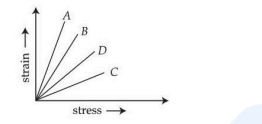
The strain-stress plot for materials $A, B, C$ and $D$ is shown in the figure. Which material has the largest Young's modulus ?
- An ideal gas at pressure $P$ and temperature $T$ is expanding such that $P T^{3} = \text{constant}$. The coefficient of volume expansion of the gas is ___________.
- The surface tension of a soap solution is $3.5 \times 10^{-2}~\text{N/m}$. The work required to increase the radius of a soap bubble from $1~\text{cm}$ to $2~\text{cm}$ is $\alpha \times 10^{-6}~\text{J}$. The value of $\alpha$ is________.
($\pi = 22/7$) - The temperature of a metal strip having coefficient of linear expansion $\alpha$ is increased from $T_1$ to $T_2$ resulting in increase of its length by $\Delta L_1$. The temperature is further increased from $T_2$ to $T_3$ such that the increase in its length is $\Delta L_2$.
Given $T_3 + T_1 = 2T_2$ and $T_2 - T_1 = \Delta T$, the value of $\Delta L_2$ is _______. - A lift of mass 1600 kg is supported by thick iron wire. If the maximum stress which the wire can withstand is $4 \times 10^8 \text{ N/m}^2$ and its radius is 4 mm, then maximum acceleration the lift can take is _________ $\text{m/s}^2$.
(take $g = 10 \text{ m/s}^2$ and $\pi = 3.14$) - Given below are two statements:
Statement I: Pressure of a fluid is exerted only on a solid surface in contact as the fluid-pressure does not exist everywhere in a still fluid.
Statement II: Excess potential energy of the molecules on the surface of a liquid, when compared to interior, results in surface tension.
In the light of the above statements, choose the correct answer from the options given below A water drop of radius $1$ cm is broken into eight equal droplets. Surface tension of water is $0.075$ N $m^{-1}$. The gain in surface energy is __________$\times10^{-7}$ J.(Take $\pi = 3.14$)
A gas is kept in a container having walls which are thermally non-conducting. Initially the gas has a volume of $800 \ cm^3$ and temperature $27^{\circ}C$. The change in temperature when the gas is adiabatically compressed to $200 \ cm^3$ is:
(Take $\gamma = 1.5$; $\gamma$ is the ratio of specific heats at constant pressure and at constant volume)
- Pressure of an ideal gas, contained in a closed vessel, is increased by $0.4\%$ when heated by $1^\circ C$. Its initial temperature must be:
A wire of length 10 cm and diameter 0.5 mm is used in a bulb. The temperature of the wire is 1727°C and power radiated by the wire is 94.2 W. Its emissivity is $\frac{x}{8}$ where x =……
(Given $\sigma = 6.0 \times 10^{-8}$ W m$^{-2}$ K$^{-4}$, $\pi = 3.14$ and assume that the emissivity of wire material is same at all wavelength.)
Important Questions from Physical and Thermal Properties of Bulk Matter
The strain-stress plot for materials $A, B, C$ and $D$ is shown in the figure. Which material has the largest Young's modulus ?
- An ideal gas at pressure $P$ and temperature $T$ is expanding such that $P T^{3} = \text{constant}$. The coefficient of volume expansion of the gas is ___________.
- The surface tension of a soap solution is $3.5 \times 10^{-2}~\text{N/m}$. The work required to increase the radius of a soap bubble from $1~\text{cm}$ to $2~\text{cm}$ is $\alpha \times 10^{-6}~\text{J}$. The value of $\alpha$ is________.
($\pi = 22/7$) - The temperature of a metal strip having coefficient of linear expansion $\alpha$ is increased from $T_1$ to $T_2$ resulting in increase of its length by $\Delta L_1$. The temperature is further increased from $T_2$ to $T_3$ such that the increase in its length is $\Delta L_2$.
Given $T_3 + T_1 = 2T_2$ and $T_2 - T_1 = \Delta T$, the value of $\Delta L_2$ is _______. - A lift of mass 1600 kg is supported by thick iron wire. If the maximum stress which the wire can withstand is $4 \times 10^8 \text{ N/m}^2$ and its radius is 4 mm, then maximum acceleration the lift can take is _________ $\text{m/s}^2$.
(take $g = 10 \text{ m/s}^2$ and $\pi = 3.14$)


