
Ideal Gas Law at Constant Volume
For an ideal gas contained in a closed vessel, the volume ($V$) remains constant. The ideal gas law states $PV = nRT$. Since the amount of gas ($n$) and the universal gas constant ($R$) are constant, we have $P \propto T$ when $V$ is constant.
This relationship can be expressed as a ratio:
$ \frac{P_1}{T_1} = \frac{P_2}{T_2} $
where $P_1, T_1$ are the initial pressure and absolute temperature, and $P_2, T_2$ are the final pressure and absolute temperature.
Calculating Initial Temperature
Let the initial absolute temperature be $T_1$ (in Kelvin).
The temperature increases by $1^\circ C$. A change of $1^\circ C$ is equivalent to a change of $1 \text{ K}$ in absolute temperature. So, the final absolute temperature is:
$ T_2 = T_1 + 1 \text{ K} $
The pressure increases by $0.4\%$. The final pressure $P_2$ is:
$ P_2 = P_1 + 0.004 P_1 = 1.004 P_1 $
Step-by-Step Derivation
- Substitute the expressions for $P_2$ and $T_2$ into the constant volume gas law ratio:
$ \frac{P_1}{T_1} = \frac{1.004 P_1}{T_1 + 1} $
- Since $P_1$ is non-zero, we can cancel it from both sides:
$ \frac{1}{T_1} = \frac{1.004}{T_1 + 1} $
- Cross-multiply:
$ T_1 + 1 = 1.004 T_1 $
- Rearrange the terms to solve for $T_1$:
$ 1 = 1.004 T_1 - T_1 $
$ 1 = (1.004 - 1) T_1 $
$ 1 = 0.004 T_1 $
- Calculate the initial temperature $T_1$:
$ T_1 = \frac{1}{0.004} = \frac{1000}{4} $
$ T_1 = 250 \text{ K} $
The initial temperature of the ideal gas must be $250 \text{ K}$.
Similar Questions
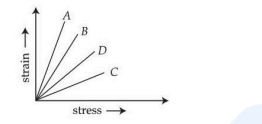
The strain-stress plot for materials $A, B, C$ and $D$ is shown in the figure. Which material has the largest Young's modulus ?
- Eight mercury drops, each of radius $r$, coalesce to form a bigger drop. The surface energy released in this process is ___________. ($\text{S}$ is the surface tension of mercury).
- An ideal gas at pressure $P$ and temperature $T$ is expanding such that $P T^{3} = \text{constant}$. The coefficient of volume expansion of the gas is ___________.
- The surface tension of a soap solution is $3.5 \times 10^{-2}~\text{N/m}$. The work required to increase the radius of a soap bubble from $1~\text{cm}$ to $2~\text{cm}$ is $\alpha \times 10^{-6}~\text{J}$. The value of $\alpha$ is________.
($\pi = 22/7$) - The temperature of a metal strip having coefficient of linear expansion $\alpha$ is increased from $T_1$ to $T_2$ resulting in increase of its length by $\Delta L_1$. The temperature is further increased from $T_2$ to $T_3$ such that the increase in its length is $\Delta L_2$.
Given $T_3 + T_1 = 2T_2$ and $T_2 - T_1 = \Delta T$, the value of $\Delta L_2$ is _______. - A lift of mass 1600 kg is supported by thick iron wire. If the maximum stress which the wire can withstand is $4 \times 10^8 \text{ N/m}^2$ and its radius is 4 mm, then maximum acceleration the lift can take is _________ $\text{m/s}^2$.
(take $g = 10 \text{ m/s}^2$ and $\pi = 3.14$) - Given below are two statements:
Statement I: Pressure of a fluid is exerted only on a solid surface in contact as the fluid-pressure does not exist everywhere in a still fluid.
Statement II: Excess potential energy of the molecules on the surface of a liquid, when compared to interior, results in surface tension.
In the light of the above statements, choose the correct answer from the options given below A water drop of radius $1$ cm is broken into eight equal droplets. Surface tension of water is $0.075$ N $m^{-1}$. The gain in surface energy is __________$\times10^{-7}$ J.(Take $\pi = 3.14$)
A gas is kept in a container having walls which are thermally non-conducting. Initially the gas has a volume of $800 \ cm^3$ and temperature $27^{\circ}C$. The change in temperature when the gas is adiabatically compressed to $200 \ cm^3$ is:
(Take $\gamma = 1.5$; $\gamma$ is the ratio of specific heats at constant pressure and at constant volume)
A wire of length 10 cm and diameter 0.5 mm is used in a bulb. The temperature of the wire is 1727°C and power radiated by the wire is 94.2 W. Its emissivity is $\frac{x}{8}$ where x =……
(Given $\sigma = 6.0 \times 10^{-8}$ W m$^{-2}$ K$^{-4}$, $\pi = 3.14$ and assume that the emissivity of wire material is same at all wavelength.)
Important Questions from Physical and Thermal Properties of Bulk Matter
The strain-stress plot for materials $A, B, C$ and $D$ is shown in the figure. Which material has the largest Young's modulus ?
- Eight mercury drops, each of radius $r$, coalesce to form a bigger drop. The surface energy released in this process is ___________. ($\text{S}$ is the surface tension of mercury).
- An ideal gas at pressure $P$ and temperature $T$ is expanding such that $P T^{3} = \text{constant}$. The coefficient of volume expansion of the gas is ___________.
- The surface tension of a soap solution is $3.5 \times 10^{-2}~\text{N/m}$. The work required to increase the radius of a soap bubble from $1~\text{cm}$ to $2~\text{cm}$ is $\alpha \times 10^{-6}~\text{J}$. The value of $\alpha$ is________.
($\pi = 22/7$) - The temperature of a metal strip having coefficient of linear expansion $\alpha$ is increased from $T_1$ to $T_2$ resulting in increase of its length by $\Delta L_1$. The temperature is further increased from $T_2$ to $T_3$ such that the increase in its length is $\Delta L_2$.
Given $T_3 + T_1 = 2T_2$ and $T_2 - T_1 = \Delta T$, the value of $\Delta L_2$ is _______.


