
The strain-stress plot for materials $A, B, C$ and $D$ is shown in the figure. Which material has the largest Young's modulus ? 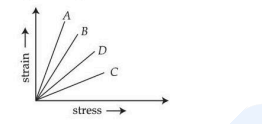
To determine which material has the largest Young's modulus, we need to review the concept of Young's modulus and analyze the given strain-stress plot for materials \(A, B, C,\) and \(D\).
Concept:
- Young's modulus, denoted as \(E\), is a measure of the stiffness of a material.
- It is defined as the ratio of stress (force per unit area) to strain (proportional deformation) within the elastic limit of the material.
- Mathematically, \(E = \frac{\text{stress}}{\text{strain}}\).
- On a strain-stress plot, Young's modulus is represented by the slope of the linear portion of the curve.
Analysis:
- From the graph, the slopes of the lines represent the Young's modulus for each material.
- The steeper the slope, the higher the Young's modulus.
Conclusion:
- Material \(B\) has the steepest slope among materials \(A, B, C,\) and \(D\).
- Therefore, material \(B\) has the largest Young's modulus.
Hence, the correct answer is \(B\).
Similar Questions
A wire of length 10 cm and diameter 0.5 mm is used in a bulb. The temperature of the wire is 1727°C and power radiated by the wire is 94.2 W. Its emissivity is $\frac{x}{8}$ where x =……
(Given $\sigma = 6.0 \times 10^{-8}$ W m$^{-2}$ K$^{-4}$, $\pi = 3.14$ and assume that the emissivity of wire material is same at all wavelength.)
A water drop of radius $1$ cm is broken into eight equal droplets. Surface tension of water is $0.075$ N $m^{-1}$. The gain in surface energy is __________$\times10^{-7}$ J.(Take $\pi = 3.14$)
- Two water drops of radius 'r' each coalesce to form a single large drop. If 'T' is the surface tension, then the surface energy released in this process is:
- Pressure of an ideal gas, contained in a closed vessel, is increased by $0.4\%$ when heated by $1^\circ C$. Its initial temperature must be:
A gas is kept in a container having walls which are thermally non-conducting. Initially the gas has a volume of $800 \ cm^3$ and temperature $27^{\circ}C$. The change in temperature when the gas is adiabatically compressed to $200 \ cm^3$ is:
(Take $\gamma = 1.5$; $\gamma$ is the ratio of specific heats at constant pressure and at constant volume)
- Eight mercury drops, each of radius $r$, coalesce to form a bigger drop. The surface energy released in this process is ___________. ($\text{S}$ is the surface tension of mercury).
- Match List - I with List - II.Choose the correct answer from the options given below :
List - I List - II (A) Heat capacity of body (I) $J kg^{-1}$ (B) Specific heat capacity of body (II) $J K^{-1}$ (C) Latent heat (III) $J kg^{-1} K^{-1}$ (D) Thermal conductivity (IV) $J m^{-1} K^{-1} s^{-1}$ - The surface tension of a soap solution is $3.5 \times 10^{-2}~\text{N/m}$. The work required to increase the radius of a soap bubble from $1~\text{cm}$ to $2~\text{cm}$ is $\alpha \times 10^{-6}~\text{J}$. The value of $\alpha$ is________.
($\pi = 22/7$) - A liquid drop of diameter $2\text{ mm}$ breaks into $512$ droplets. The change in surface energy is $\alpha \times 10^{-6}\text{ J}$. The value of $\alpha$ is ________. (Take surface tension of liquid = $0.08\text{ N/m}$)
- A lift of mass 1600 kg is supported by thick iron wire. If the maximum stress which the wire can withstand is $4 \times 10^8 \text{ N/m}^2$ and its radius is 4 mm, then maximum acceleration the lift can take is _________ $\text{m/s}^2$.
(take $g = 10 \text{ m/s}^2$ and $\pi = 3.14$)
Important Questions from Physical and Thermal Properties of Bulk Matter
A wire of length 10 cm and diameter 0.5 mm is used in a bulb. The temperature of the wire is 1727°C and power radiated by the wire is 94.2 W. Its emissivity is $\frac{x}{8}$ where x =……
(Given $\sigma = 6.0 \times 10^{-8}$ W m$^{-2}$ K$^{-4}$, $\pi = 3.14$ and assume that the emissivity of wire material is same at all wavelength.)
A water drop of radius $1$ cm is broken into eight equal droplets. Surface tension of water is $0.075$ N $m^{-1}$. The gain in surface energy is __________$\times10^{-7}$ J.(Take $\pi = 3.14$)
- Two water drops of radius 'r' each coalesce to form a single large drop. If 'T' is the surface tension, then the surface energy released in this process is:
- Pressure of an ideal gas, contained in a closed vessel, is increased by $0.4\%$ when heated by $1^\circ C$. Its initial temperature must be:
A gas is kept in a container having walls which are thermally non-conducting. Initially the gas has a volume of $800 \ cm^3$ and temperature $27^{\circ}C$. The change in temperature when the gas is adiabatically compressed to $200 \ cm^3$ is:
(Take $\gamma = 1.5$; $\gamma$ is the ratio of specific heats at constant pressure and at constant volume)


