
The rate of change of momentum of a body is equal to the resultant:
Force
Correct option- (c)
The rate of change of momentum of a body is equal to the force applied.
Momentum = mass × velocity
Change in momentum →
d(momentum) = mass × d(velocity)
Force = mass × acceleration
| Energy |
|
| Power |
|
| Force |
|
| Impulse |
|
Similar Questions
A person throws an object on a horizontal frictionless plane surface. It is noticed that there are two forces acting on this object -(i) gravitational pull and (ii) normal reaction of the surface. According to the third law of motion, the net resultant force is zero. Which one of the following can be said for the motion of the object?
- Which one of the following statements qualitatively explains the second law of motion ?
Important Questions from Newton's Laws of Motion
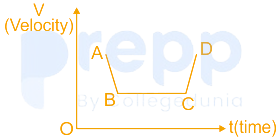
In the given velocity (V) versus time (t) graph, accelerated and decelerated motions are respectively represented by line segments
A balloon is filled with air. The mass of the air in the balloon is 10 gram. A small hole is made to the balloon and released. The balloon moves up with an average speed of 5 cm/s and shrinks completely in 5 seconds. Find the average force acting on the balloon.
A uniform rope is suspended from the roof of a building. The rope breaks if the tension in the rope is greater than 700 N.
A man of mass 50 kg climbs up the rope. Find the maximum acceleration with which he can climb up the rope (g = 10 m/s2)A ball is thrown up with a certain velocity, it attains 50 m and come back to the thrower then the
A string of certain length used to whirl a stone in a vertical circle with certain velocity. The tension developed in the string will be



