
A person throws an object on a horizontal frictionless plane surface. It is noticed that there are two forces acting on this object -(i) gravitational pull and (ii) normal reaction of the surface. According to the third law of motion, the net resultant force is zero. Which one of the following can be said for the motion of the object?
The object will move with constant velocity.
Analyzing Object Motion on a Frictionless Plane
The question describes an object placed on a horizontal frictionless plane surface, acted upon by two forces: gravitational pull and normal reaction. It also states that according to the third law of motion, the net resultant force on the object is zero. Let's break down these points to understand the object's motion.
Understanding Forces on the Object
On a horizontal surface, the main forces acting vertically on the object are:
- Gravitational Pull: The Earth pulls the object downwards. This force is also known as weight (\(W = mg\)), where \(m\) is the mass and \(g\) is the acceleration due to gravity.
- Normal Reaction: The surface pushes back up on the object, perpendicular to the surface. This force exists because the object is pressing against the surface.
Since the surface is horizontal and frictionless, there are no forces acting horizontally (unless an external horizontal force is applied, which is not mentioned in the question). The vertical forces, gravitational pull and normal reaction, are generally balanced on a horizontal surface, meaning the normal reaction is equal in magnitude and opposite in direction to the gravitational pull (\(N = mg\)), resulting in zero net vertical force.
Newton's Laws and Net Force
The question states that the net resultant force on the object is zero. While the reasoning provided ("according to the third law of motion") might be misleading (the third law describes action-reaction pairs, not necessarily balanced forces on a single object), the premise that the net force is zero is crucial. According to Newton's Second Law of Motion, the net force (\(F_{net}\)) acting on an object is equal to the product of its mass (\(m\)) and its acceleration (\(a\)):
\[F_{net} = ma\]
If the net force (\(F_{net}\)) is zero, then the equation becomes:
\[0 = ma\]
Since the object has mass (\(m \neq 0\)), the acceleration (\(a\)) must be zero.
\[a = 0\]
Acceleration is the rate of change of velocity. If the acceleration is zero, it means the velocity of the object is not changing. Velocity is a vector quantity, meaning it has both magnitude (speed) and direction.
According to Newton's First Law of Motion (also known as the Law of Inertia), an object will remain at rest or in uniform motion in a straight line unless acted upon by an external net force. Uniform motion in a straight line means moving with constant velocity.
Analyzing the Options for Object Motion
Based on the conclusion that the net resultant force is zero and therefore the acceleration is zero, let's evaluate the given options:
- Option 1: The object will move with acceleration. This is incorrect because we determined that the acceleration (\(a\)) is zero when the net force is zero.
- Option 2: The object will move with deceleration. Deceleration is negative acceleration. If the acceleration is zero, there is no deceleration. This option is incorrect.
- Option 3: The object will move with constant speed, but varying direction. If the direction of motion is varying (e.g., moving in a circle), the velocity is changing, even if the speed is constant. A change in velocity means there is acceleration (specifically, centripetal acceleration in the case of circular motion). For there to be acceleration, there must be a non-zero net force. This contradicts the premise that the net resultant force is zero. Therefore, this option is incorrect.
- Option 4: The object will move with constant velocity. Constant velocity means both the speed and the direction of motion are constant. If the object was initially at rest, it remains at rest (velocity = 0, which is constant). If the object was initially moving, it continues to move in a straight line at a constant speed. Zero acceleration implies constant velocity. This aligns with the conclusion derived from Newton's Second Law when the net force is zero. This option is correct.
Therefore, given that the net resultant force on the object is zero, the object will move with constant velocity.
Revision Table: Key Concepts of Motion
| Concept | Definition | Relation to Net Force |
|---|---|---|
| Net Force (\(F_{net}\)) | The vector sum of all forces acting on an object. | Directly proportional to acceleration (\(F_{net} = ma\)). |
| Acceleration (\(a\)) | The rate of change of velocity. | \(a = \frac{F_{net}}{m}\). If \(F_{net} = 0\), then \(a = 0\). |
| Velocity (\(v\)) | Speed in a given direction. | If acceleration is zero, velocity is constant (constant speed and constant direction). |
| Constant Velocity | Velocity that does not change in magnitude (speed) or direction. | Implies zero acceleration and zero net force. |
Additional Information on Forces and Motion
Understanding forces and their effect on motion is fundamental in physics. Here are some additional points:
- Frictionless Plane: A frictionless surface implies that there is no resistive force parallel to the surface opposing motion. This simplifies the analysis as we only need to consider gravitational and normal forces in the vertical direction, and any applied forces in the horizontal direction.
- Newton's Third Law: While the question mentions the third law, its correct application is about pairs of forces acting on *different* objects. For example, the Earth pulls down on the object (gravitational force), and the object pulls up on the Earth with an equal and opposite force. The surface pushes up on the object (normal force), and the object pushes down on the surface with an equal and opposite force. These pairs act on different bodies and do not cancel each other out to determine the motion of a single object.
- Inertia: Newton's First Law is also called the law of inertia. Inertia is the property of an object to resist changes in its state of motion (either rest or constant velocity). An object with zero net force acting on it will maintain its current state of motion due to inertia.
In summary, if the net force on an object is zero, regardless of the individual forces acting on it (as long as they sum to zero), the object will have zero acceleration and will move with constant velocity.
Similar Questions
- Which one of the following statements qualitatively explains the second law of motion ?
Important Questions from Newton's Laws of Motion
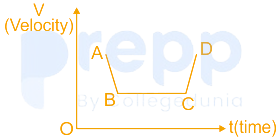
In the given velocity (V) versus time (t) graph, accelerated and decelerated motions are respectively represented by line segments
A balloon is filled with air. The mass of the air in the balloon is 10 gram. A small hole is made to the balloon and released. The balloon moves up with an average speed of 5 cm/s and shrinks completely in 5 seconds. Find the average force acting on the balloon.
A uniform rope is suspended from the roof of a building. The rope breaks if the tension in the rope is greater than 700 N.
A man of mass 50 kg climbs up the rope. Find the maximum acceleration with which he can climb up the rope (g = 10 m/s2)A ball is thrown up with a certain velocity, it attains 50 m and come back to the thrower then the
A string of certain length used to whirl a stone in a vertical circle with certain velocity. The tension developed in the string will be



