
The location of closed loop poles of a LTI system is given as shown in the figure : The system will be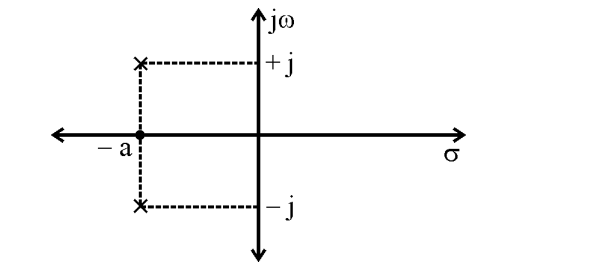
Absolutely stable
To determine the stability of the system, we need to analyze the location of the closed-loop poles in the complex plane.
The poles of a Linear Time-Invariant (LTI) system in the complex plane are represented as follows:
- Real Axis: The horizontal axis represents the real part (σ).
- Imaginary Axis: The vertical axis represents the imaginary part (jω).
In control systems:
- A system is absolutely stable if all the poles of its closed-loop transfer function have negative real parts. This implies that the poles are in the left half of the complex plane.
- A system is marginally stable if any poles lie on the imaginary axis and all other poles have negative real parts.
- A system is unstable if any poles have positive real parts.
- A system is relatively stable if it is stable and meets additional specific gain margin or phase margin requirements.
The provided pole locations are:
- Complex conjugate pole pair, represented as \(-a \pm j\omega\).
Since all the poles are in the left half of the complex plane, this indicates that the system is absolutely stable.
Conclusion: The correct answer is Absolutely stable.
Similar Questions
In a closed loop automatic control system, the sequence of operations is as follows :
(i) Controlling unit
(ii) Correcting unit
(iii) Impact on the process
(iv) Measurement of process parametersThe block diagram of a control system in given below
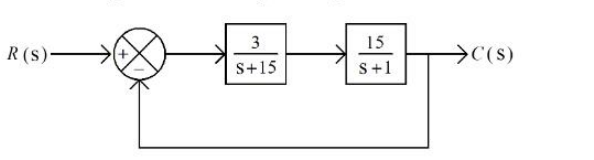
A. The root of characteristics equation is 6
B. The root of characteristics equation is -6
C. The root of characteristics equation is 5
D. The root of characteristics equation is -10
E. The root of characteristics equation is -5
Choose the most appropriate answer from the options given below :
A negative feedback control system whose open loop transfer function G(S) has feedback transfer function H(S) can be replaced by a single block with transfer function :
Important Questions from Closed Loop Control Systems
Which of the following statements about the closed-loop control system compared to open-loop control system is INCORRECT?
Using negative feedback for improvements, which statement is false
Open loop transfer function of a closed loop control system is defined as:
The impulse response of the transfer function 1 is
Consider the following statements:
A. The effect of feedback is to reduce the system error.
B. Feedback increases the gain of the system is one frequency range but decreases in another.
C. Feedback can cause a system that is originally stable to become unstable.
Which of these statements are correct?



