
A negative feedback control system whose open loop transfer function G(S) has feedback transfer function H(S) can be replaced by a single block with transfer function :
\(\dfrac{G(S)}{1+G(S)H(S)}\)
Derive it from the loop equations. With input R, output C, error E and negative feedback:
\(E=R-H(s)C, \qquad C=G(s)E\)
Substituting the first into the second,
\(C=G(s)\left[R-H(s)C\right]=G(s)R-G(s)H(s)C\)
Collecting the C terms,
\(C\left[1+G(s)H(s)\right]=G(s)R\)
\(T(s)=\dfrac{C}{R}=\dfrac{G(s)}{1+G(s)H(s)}\)
which is option 1.
Two structural checks that identify it without any algebra.
The numerator must be G, not H. The forward path carries the signal from input to output, so the closed-loop gain must reduce to G when the feedback is removed. Setting H = 0 in option 1 gives exactly \(T=G\) ✓. Options 3 and 4 would give H, which is absurd — with no feedback the answer would depend only on the feedback element.
The sign must be plus. Negative feedback subtracts at the summing junction, which puts \(+GH\) in the denominator; positive feedback gives \(1-GH\). That eliminates option 2.
The general form worth memorising.
\(T(s)=\dfrac{\text{forward path gain}}{1\mp(\text{loop gain})}\)
with the minus sign for positive feedback and the plus sign for negative feedback. For unity feedback, H = 1 and the result reduces to \(G/(1+G)\).
What the denominator means. Setting it to zero,
\(1+G(s)H(s)=0\)
gives the characteristic equation, whose roots are the closed-loop poles. Every stability tool in control theory is an examination of this one expression: the root locus traces its roots as gain varies, the Nyquist criterion counts encirclements of the point \(-1\) by GH, and Routh–Hurwitz tests its coefficients.
Why negative feedback is used. When the loop gain is large, \(|GH|\gg1\), the expression collapses to \(T\approx1/H\) — the closed-loop behaviour is set almost entirely by the feedback element and becomes nearly independent of G. Since G is the part that drifts with temperature, ageing and device spread, this is precisely what buys accuracy and repeatability.
Hence, the equivalent single block is \(\dfrac{G(S)}{1+G(S)H(S)}\).
Similar Questions
In a closed loop automatic control system, the sequence of operations is as follows :
(i) Controlling unit
(ii) Correcting unit
(iii) Impact on the process
(iv) Measurement of process parametersThe block diagram of a control system in given below
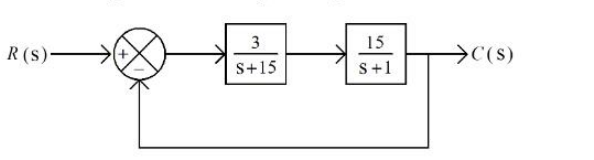
A. The root of characteristics equation is 6
B. The root of characteristics equation is -6
C. The root of characteristics equation is 5
D. The root of characteristics equation is -10
E. The root of characteristics equation is -5
Choose the most appropriate answer from the options given below :
The location of closed loop poles of a LTI system is given as shown in the figure :
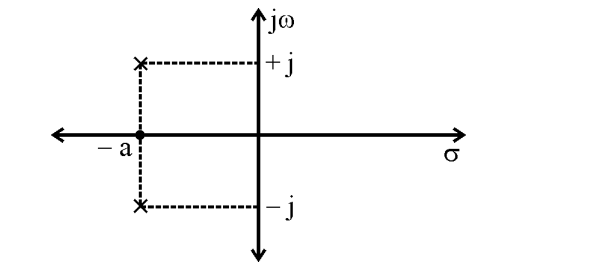
The system will be
Important Questions from Closed Loop Control Systems
Which of the following statements about the closed-loop control system compared to open-loop control system is INCORRECT?
Using negative feedback for improvements, which statement is false
Open loop transfer function of a closed loop control system is defined as:
The impulse response of the transfer function 1 is
Consider the following statements:
A. The effect of feedback is to reduce the system error.
B. Feedback increases the gain of the system is one frequency range but decreases in another.
C. Feedback can cause a system that is originally stable to become unstable.
Which of these statements are correct?



