
In a closed loop automatic control system, the sequence of operations is as follows : (i) Controlling unit
(ii) Correcting unit
(iii) Impact on the process
(iv) Measurement of process parameters
(iv), (ii), (i) and (iii)
(iv), (ii), (i) and (iii) — option (D), as recorded in the official key.
The four elements of a closed loop. Every feedback control system contains the same functional blocks, whatever the application :
| Element | Function | Physical example |
|---|---|---|
| (iv) Measurement of process parameters | Senses the controlled variable and reports its present value | Thermocouple, tachometer, flow meter |
| (i) Controlling unit | Compares measurement with the set point and computes the corrective signal | PID controller, comparator plus amplifier |
| (ii) Correcting unit | The final control element that applies the correction | Control valve, motor, heater, actuator |
| (iii) Impact on the process | The controlled variable changes in response | Temperature rises, shaft speed changes |
Why the ordering question is subtle. A loop has no beginning — it is a cycle, and any of the four can be taken as the starting point. What fixes the answer is only the relative order in which the blocks follow one another round the loop. The key begins at measurement, and its sequence closes the cycle back to the process.
The counter-argument, stated plainly, since a careful candidate will notice it. The conventional signal path runs measurement → controller → correcting element → process: the sensor reports, the controller decides how much correction is needed, the actuator applies it, and the process responds. On that reading the sequence would be (iv), (i), (ii), (iii) — option (B). Placing the correcting unit before the controlling unit, as the key does, reverses the decide-then-act order that most textbooks set out. The answer stored here follows the official key; the standard signal path is as just described.
What actually matters about the loop, and is examinable either way :
| Open loop | Closed loop | |
|---|---|---|
| Feedback | None — output is not measured | Present — output is fed back and compared |
| Accuracy | Depends entirely on calibration | Self-correcting against disturbances and drift |
| Stability | Always stable | Can oscillate — the price of feedback |
| Effect on gain error | Full error appears at the output | Divided by \(1+GH\) |
The closed-loop transfer function \(\dfrac{C}{R}=\dfrac{G}{1+GH}\) contains the whole story: the feedback term suppresses parameter variation and disturbance, but its denominator is also the characteristic equation whose roots decide whether the system is stable.
Hence, the answer recorded is (iv), (ii), (i) and (iii).
Similar Questions
The block diagram of a control system in given below
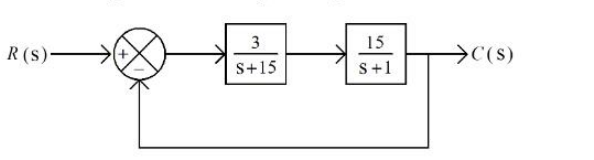
A. The root of characteristics equation is 6
B. The root of characteristics equation is -6
C. The root of characteristics equation is 5
D. The root of characteristics equation is -10
E. The root of characteristics equation is -5
Choose the most appropriate answer from the options given below :
The location of closed loop poles of a LTI system is given as shown in the figure :
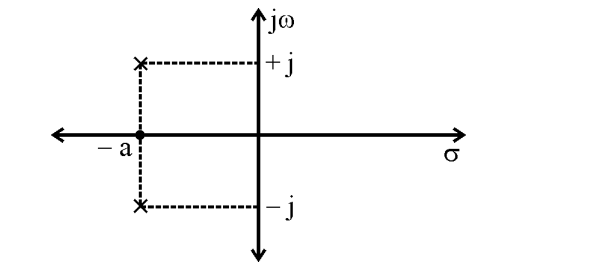
The system will be
A negative feedback control system whose open loop transfer function G(S) has feedback transfer function H(S) can be replaced by a single block with transfer function :
Important Questions from Closed Loop Control Systems
Which of the following statements about the closed-loop control system compared to open-loop control system is INCORRECT?
Using negative feedback for improvements, which statement is false
Open loop transfer function of a closed loop control system is defined as:
The impulse response of the transfer function 1 is
Consider the following statements:
A. The effect of feedback is to reduce the system error.
B. Feedback increases the gain of the system is one frequency range but decreases in another.
C. Feedback can cause a system that is originally stable to become unstable.
Which of these statements are correct?



