
The block diagram of a control system in given below A. The root of characteristics equation is 6 B. The root of characteristics equation is -6 C. The root of characteristics equation is 5 D. The root of characteristics equation is -10 E. The root of characteristics equation is -5 Choose the most appropriate answer from the options given below :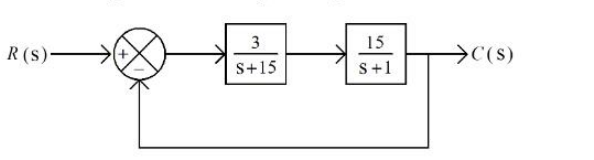
B and D only
Read the block diagram. It is a unity negative-feedback system with two cascaded blocks in the forward path:
\(G_1(s)=\dfrac{3}{s+15}, \qquad G_2(s)=\dfrac{15}{s+1}\)
Step 1 — combine the cascade (series blocks multiply):
\(G(s)=\dfrac{3}{s+15}\times\dfrac{15}{s+1}=\dfrac{45}{(s+15)(s+1)}\)
Step 2 — write the characteristic equation. For unity feedback the closed-loop transfer function is \(\dfrac{G}{1+G}\), so the characteristic equation is the denominator set to zero:
\(1+G(s)=0 \Rightarrow 1+\dfrac{45}{(s+15)(s+1)}=0\)
Step 3 — clear the fraction and expand.
\((s+15)(s+1)+45=0\)
\(s^{2}+16s+15+45=0\)
\(s^{2}+16s+60=0\)
Step 4 — solve the quadratic.
\(s=\dfrac{-16\pm\sqrt{16^{2}-4(60)}}{2}=\dfrac{-16\pm\sqrt{256-240}}{2}=\dfrac{-16\pm 4}{2}\)
\(s=-6 \quad\text{and}\quad s=-10\)
(Quick check by factorising: \(s^{2}+16s+60=(s+6)(s+10)\) ✓, since 6 + 10 = 16 and 6 × 10 = 60.)
These match statements B (root = −6) and D (root = −10).
Why the positive roots in A and C are impossible here. All the coefficients of \(s^{2}+16s+60\) are positive, so by Descartes' rule (and by Routh–Hurwitz) there can be no root with a positive real part. Physically, the closed-loop poles at −6 and −10 are both in the left half plane, so this system is stable and its response is over-damped (two distinct real poles), with the slower pole at −6 dominating the settling time.
Note the shift caused by feedback. The open-loop poles were at −1 and −15; closing the loop with gain 45 pulls them together to −6 and −10 — a nice illustration of how root-locus branches move as loop gain rises.
Hence, the roots of the characteristic equation are −6 and −10, i.e. B and D only.
Similar Questions
In a closed loop automatic control system, the sequence of operations is as follows :
(i) Controlling unit
(ii) Correcting unit
(iii) Impact on the process
(iv) Measurement of process parametersThe location of closed loop poles of a LTI system is given as shown in the figure :
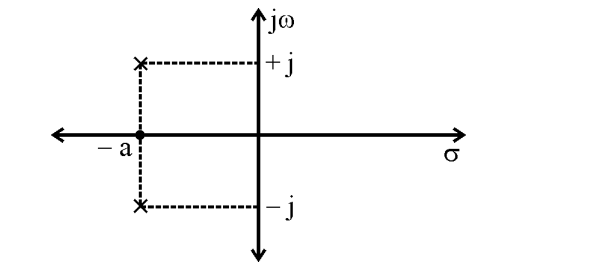
The system will be
A negative feedback control system whose open loop transfer function G(S) has feedback transfer function H(S) can be replaced by a single block with transfer function :
Important Questions from Closed Loop Control Systems
Which of the following statements about the closed-loop control system compared to open-loop control system is INCORRECT?
Using negative feedback for improvements, which statement is false
Open loop transfer function of a closed loop control system is defined as:
The impulse response of the transfer function 1 is
Consider the following statements:
A. The effect of feedback is to reduce the system error.
B. Feedback increases the gain of the system is one frequency range but decreases in another.
C. Feedback can cause a system that is originally stable to become unstable.
Which of these statements are correct?



