
A linear time-invariant system initially at rest, when subjected to a unit step input, gives a response y(t) = te -t, t > 0. The transfer function of the system is:
System Transfer Function Derivation
To determine the transfer function of a linear time-invariant (LTI) system, we use the fundamental concept that for a system initially at rest, the transfer function \(H(s)\) is the ratio of the Laplace transform of its output \(Y(s)\) to the Laplace transform of its input \(X(s)\).
The formula for the transfer function is given by:
\[H(s) = \frac{Y(s)}{X(s)}\]
- \(Y(s)\) represents the Laplace transform of the system's output signal, \(y(t)\).
- \(X(s)\) represents the Laplace transform of the system's input signal, \(x(t)\).
Input Signal Properties
The problem states that the LTI system is subjected to a unit step input. A unit step function, commonly denoted as \(u(t)\) or \(x(t)\), is defined as:
\[u(t) = \begin{cases} 1 & \text{for } t \ge 0 \\ 0 & \text{for } t < 0 \end{cases}\]
The Laplace transform of the unit step input \(u(t)\) is a standard result:
\[X(s) = L\{u(t)\} = \frac{1}{s}\]
Output Response Transformation
The given output response of the system for \(t > 0\) is \(y(t) = te^{-t}\).
To find its Laplace transform \(Y(s)\), we can use known Laplace transform properties:
First, recall the Laplace transform of \(t\):
\[L\{t\} = \frac{1}{s^2}\]
Next, we apply the frequency shifting property (also known as the complex frequency shift theorem). This property states that if \(L\{f(t)\} = F(s)\), then \(L\{e^{at}f(t)\} = F(s-a)\).
In our case, \(f(t) = t\) and the exponential term is \(e^{-t}\), which means \(a = -1\).
Applying the frequency shifting property to \(y(t) = te^{-t}\):
\[Y(s) = L\{te^{-t}\} = \left. \frac{1}{s^2} \right|_{s \to s - (-1)} = \left. \frac{1}{s^2} \right|_{s \to s + 1}\]
Therefore, the Laplace transform of the output response is:
\[Y(s) = \frac{1}{{(s+1)^2}}\]
Transfer Function Derivation
Now, we can calculate the transfer function \(H(s)\) using the derived \(Y(s)\) and \(X(s)\):
\[H(s) = \frac{Y(s)}{X(s)}\]
Substitute the expressions for \(Y(s)\) and \(X(s)\):
\[H(s) = \frac{\frac{1}{{(s+1)^2}}}{\frac{1}{s}}\]
To simplify this complex fraction, we invert the denominator and multiply:
\[H(s) = \frac{1}{{(s+1)^2}} \times s\]
\[H(s) = \frac{s}{{(s+1)^2}}\]
Solution Options Comparison
Let's compare our derived transfer function with the given options to find the correct one:
- Option 1: \(\frac{1}{{{{\left( {s + 1} \right)}^2}}}\)
- Option 2: \(\frac{1}{{s{{\left( {s + 1} \right)}^2}}}\)
- Option 3: \(\frac{s}{{{{\left( {s + 1} \right)}^2}}}\)
- Option 4: \(\frac{1}{{s + 1}}\)
The calculated transfer function, \(H(s) = \frac{s}{{(s+1)^2}}\), perfectly matches Option 3.
Important Questions from Closed Loop Control Systems
In a closed loop automatic control system, the sequence of operations is as follows :
(i) Controlling unit
(ii) Correcting unit
(iii) Impact on the process
(iv) Measurement of process parametersThe block diagram of a control system in given below
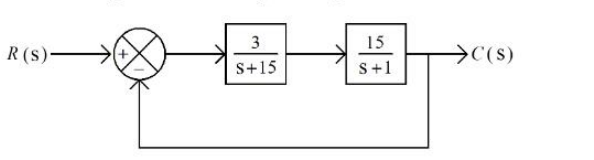
A. The root of characteristics equation is 6
B. The root of characteristics equation is -6
C. The root of characteristics equation is 5
D. The root of characteristics equation is -10
E. The root of characteristics equation is -5
Choose the most appropriate answer from the options given below :
The location of closed loop poles of a LTI system is given as shown in the figure :
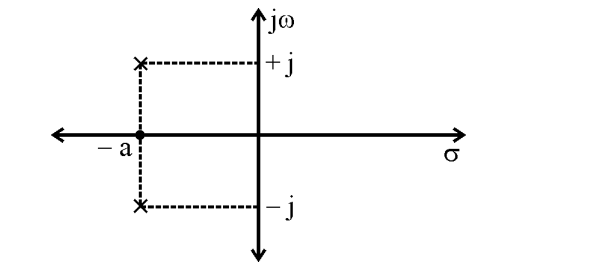
The system will be
A negative feedback control system whose open loop transfer function G(S) has feedback transfer function H(S) can be replaced by a single block with transfer function :
The effect of Tachometer feedback in a control system is to reduce -


