
The differences between the oscillators and amplifiers are A. Oscillators do not have any input voltage B. Amplifiers do not have any input voltage C. Oscillators do not have positive feedback D. Amplifiers do not have positive feedback E. Both of them are stable circuit Choose the correct answer from the options given below :
A and D only
An amplifier reproduces an enlarged copy of a signal applied to it; an oscillator manufactures a periodic signal by itself. Test each statement against that distinction.
A — "Oscillators do not have any input voltage." TRUE. An oscillator has only a d.c. supply and no external signal input. Oscillation builds up from the circuit's own thermal noise or a power-supply transient: the noise component at the design frequency is fed back in phase, is amplified round the loop, and grows until the amplifier's non-linearity limits the amplitude.
B — "Amplifiers do not have any input voltage." FALSE. With no input, an amplifier's output is just its quiescent d.c. level; it produces an output only in response to an applied signal.
C — "Oscillators do not have positive feedback." FALSE. Positive (regenerative) feedback is exactly what an oscillator needs. Sustained oscillation requires the Barkhausen criterion:
\(|A\beta| = 1 \qquad \text{and} \qquad \angle A\beta = 0^{\circ}\ (\text{or } 360^{\circ})\)
i.e. unity loop gain with the feedback signal in phase with the input. (For start-up one designs |Aβ| slightly greater than 1.)
D — "Amplifiers do not have positive feedback." TRUE in the sense intended: practical amplifiers use negative feedback, which trades gain for benefits — stabilised gain set by passive components, wider bandwidth, lower distortion, and controlled input/output impedances. Applying positive feedback to an amplifier would push it toward instability, which is precisely how one turns an amplifier into an oscillator.
E — "Both of them are stable circuits." FALSE as a difference. The question asks for differences, and this statement asserts a similarity; moreover an oscillator is deliberately operated at the edge of instability, so it is not "stable" in the control-theory sense at all.
The valid differences are A and D.
Underlying gain relation. With feedback, \(A_f=\dfrac{A}{1\mp A\beta}\): the minus sign (positive feedback) drives the gain toward infinity as Aβ → 1, which is the oscillation condition, while the plus sign (negative feedback) reduces and stabilises the gain, which is the amplifier condition.
Hence, the correct answer is A and D only.
Similar Questions
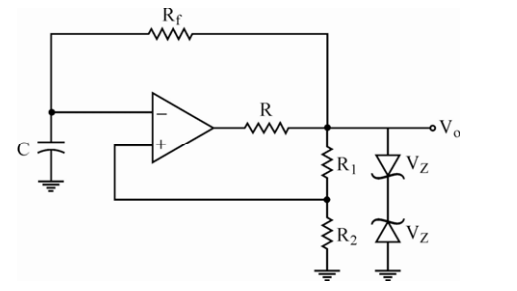
The circuit shown below is a
If a certain oscillator, Av = 50, the attenuation of the feedback circuit must be :
Important Questions from Oscillators and Feedback Amplifier
A relaxation oscillator is one which:
- A crystal has a thickness of 10 mm. If the thickness is reduced by 2%, the frequency of oscillations will _________.
In a phase shift oscillator, the frequency determining elements are _____.
- A relaxation oscillator produces
In a voltage series feedback amplifier, if R iis the input resistance without feedback. then input resistance with feedback is:



