
The circuit shown below is a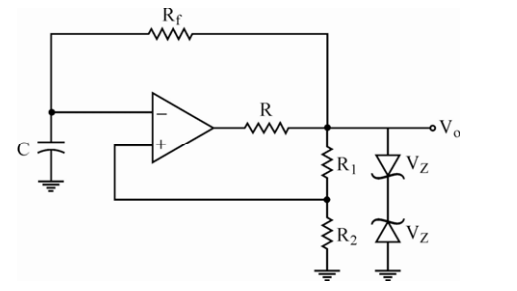
Free running multivibrator
Identify the two feedback paths — that is what distinguishes every circuit in the option list.
Positive feedback: the R1–R2 divider returns a fraction of the output to the non-inverting input. This gives hysteresis: the comparator threshold is
\(\pm\beta V_Z, \qquad \beta=\dfrac{R_1}{R_1+R_2}\)
where the back-to-back zeners clamp the output at ±VZ.
Negative feedback through a capacitor: Rf and C form a timing branch on the inverting input, so that node cannot follow the output instantly — it charges exponentially towards it.
How the circuit behaves. Suppose the output is at +VZ. The capacitor charges through Rf towards that level. The moment its voltage passes the upper threshold +βVZ, the comparator flips to −VZ; the capacitor then discharges and recharges towards the negative rail until it crosses −βVZ, and the output flips again. The cycle repeats indefinitely with period
\(T=2R_fC\ln\!\left(\dfrac{1+\beta}{1-\beta}\right)\)
The key point: nothing triggers it. There is no external input at all — the circuit oscillates on its own, producing a square wave at the output and an exponential (roughly triangular) waveform on the capacitor. A self-starting oscillator with two quasi-stable states is a free-running (astable) multivibrator.
Why the other three are wrong.
A monostable has one stable state and needs an external trigger pulse to produce a single timed output; the giveaway is a trigger input and usually a clamping diode, neither of which is present.
A comparator has an input signal applied to one terminal and no feedback at all.
A Schmitt trigger does have the positive-feedback divider, but its inverting input receives an external signal; here that input is occupied by the timing capacitor, which is exactly what converts a Schmitt trigger into an astable.
Hence, the circuit is a free running multivibrator.
Similar Questions
The differences between the oscillators and amplifiers are
A. Oscillators do not have any input voltage
B. Amplifiers do not have any input voltage
C. Oscillators do not have positive feedback
D. Amplifiers do not have positive feedback
E. Both of them are stable circuit
Choose the correct answer from the options given below :
If a certain oscillator, Av = 50, the attenuation of the feedback circuit must be :
Important Questions from Oscillators and Feedback Amplifier
A relaxation oscillator is one which:
- A crystal has a thickness of 10 mm. If the thickness is reduced by 2%, the frequency of oscillations will _________.
In a phase shift oscillator, the frequency determining elements are _____.
- A relaxation oscillator produces
In a voltage series feedback amplifier, if R iis the input resistance without feedback. then input resistance with feedback is:



