
The Barkhausen criteria is:
|Aβ| = 1
Barkhausen Criteria Explained
The Barkhausen criteria define the conditions required for an electronic circuit, typically an amplifier with feedback, to oscillate. Oscillations are continuous, repetitive variations in voltage or current. For a circuit to sustain oscillations, the signal fed back must be in phase with the input signal and have sufficient amplitude.
Conditions for Oscillation
The Barkhausen criteria state two essential conditions:
- Phase Shift Condition: The total phase shift of the signal around the feedback loop must be zero degrees (0°) or an integer multiple of 360° (like 360°, 720°, etc.). This ensures that the feedback signal reinforces the original signal.
- Amplitude Condition: The magnitude of the product of the amplifier's gain (A) and the feedback factor (β) must be exactly equal to unity (1). This product, known as the loop gain, is represented as Aβ. Mathematically, this condition is expressed as |Aβ| = 1.
Analyzing the Options
Let's examine the given options in light of the Barkhausen criteria:
- A = -β: This option relates to the phase condition where the phase shift is 180°. While a 180° phase shift combined with a loop gain magnitude of 1 leads to oscillation, this expression alone doesn't represent the complete criteria, specifically the magnitude requirement.
- A = β: This option implies unity gain and zero phase shift, but it's an incomplete representation and often incorrect in practice as gains are usually complex numbers. It doesn't capture the necessary magnitude requirement correctly.
- |Aβ| = 1: This option correctly represents the amplitude condition of the Barkhausen criteria. It states that the magnitude of the loop gain must be exactly 1 for sustained oscillations.
- |Aβ| = -1: This option is incorrect. While Aβ can be negative (indicating a 180° phase shift), the magnitude |Aβ| must be positive and equal to 1. The magnitude of a number cannot be -1.
Conclusion
The Barkhausen criteria are essential for understanding how oscillators work. The core requirement for sustained oscillation is that the loop gain's magnitude must be unity (|Aβ| = 1) and the loop phase shift must be 0° or 360°. Therefore, the option |Aβ| = 1 accurately represents the amplitude condition of the Barkhausen criteria.
Important Questions from Oscillators and Feedback Amplifier
The differences between the oscillators and amplifiers are
A. Oscillators do not have any input voltage
B. Amplifiers do not have any input voltage
C. Oscillators do not have positive feedback
D. Amplifiers do not have positive feedback
E. Both of them are stable circuit
Choose the correct answer from the options given below :
The circuit shown below is a
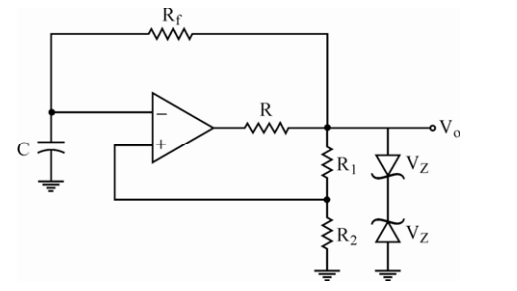
If a certain oscillator, Av = 50, the attenuation of the feedback circuit must be :
The output of the phase detector in a phase-locked loop is ____________.
In the circuit below, the opamp is ideal.
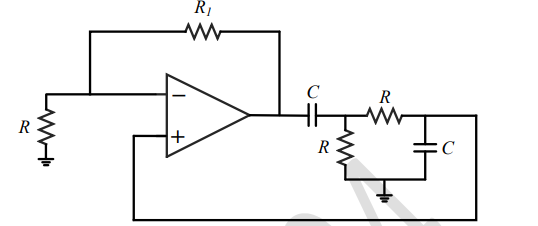
If the circuit is to show sustained oscillations, the respective values of $𝑅_1$ and the corresponding frequency of oscillation are _____.


