
If a certain oscillator, Av = 50, the attenuation of the feedback circuit must be :
0.02
The Barkhausen criterion. For sustained oscillation the loop gain must be exactly unity in magnitude and the loop phase shift must be zero (or a multiple of 360°):
\(A_v\beta=1, \qquad \angle A_v\beta=0^{\circ}\)
Step — solve for the feedback factor.
\(\beta=\dfrac{1}{A_v}=\dfrac{1}{50}=0.02\)
which is option 4.
Why "attenuation" is the right word for β. The feedback network is passive, so it can only reduce the signal: it returns 1/50 of the output to the input. The amplifier then makes up exactly the factor of 50 that the network threw away, and the signal circulates round the loop with unchanged amplitude — which is what "sustained" oscillation means.
The distractors and the errors behind them.
| Option | Where it comes from |
|---|---|
| 1 | Confusing the loop gain Aβ = 1 with β itself |
| 0.01 | Using 1/100 — the reciprocal of twice the gain |
| 10 | A β greater than 1 would require the passive network to amplify, which is impossible |
What happens if the product is not exactly 1.
If Aβ < 1 the loop loses a little on each circuit and any disturbance dies away — no oscillation starts.
If Aβ > 1 the amplitude grows on every circuit until the amplifier clips, so the waveform is a distorted square rather than a sine.
In practice the loop is designed with Aβ slightly greater than 1 so that oscillation is certain to start from noise, and an amplitude-limiting element — a thermistor, a lamp, back-to-back diodes, or simply the onset of gentle saturation — then pulls the effective gain back to exactly 1 at the working amplitude. The Wien-bridge oscillator's incandescent lamp is the classic example.
The phase half of the criterion. Magnitude alone is not enough. An RC phase-shift oscillator uses three RC sections to supply 180° to add to the amplifier's own 180°, and at that frequency its attenuation happens to be 1/29 — which is exactly why such an oscillator needs an amplifier gain of at least 29.
Hence, the feedback attenuation must be 0.02.
Similar Questions
The differences between the oscillators and amplifiers are
A. Oscillators do not have any input voltage
B. Amplifiers do not have any input voltage
C. Oscillators do not have positive feedback
D. Amplifiers do not have positive feedback
E. Both of them are stable circuit
Choose the correct answer from the options given below :
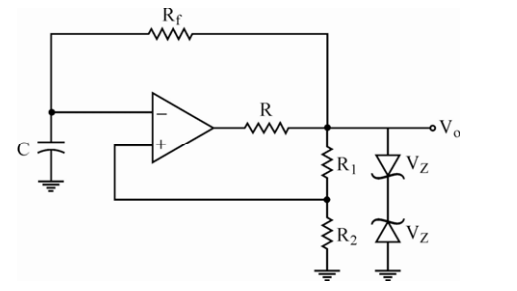
The circuit shown below is a
Important Questions from Oscillators and Feedback Amplifier
A relaxation oscillator is one which:
- A crystal has a thickness of 10 mm. If the thickness is reduced by 2%, the frequency of oscillations will _________.
In a phase shift oscillator, the frequency determining elements are _____.
- A relaxation oscillator produces
In a voltage series feedback amplifier, if R iis the input resistance without feedback. then input resistance with feedback is:



