
In the circuit below, the opamp is ideal. 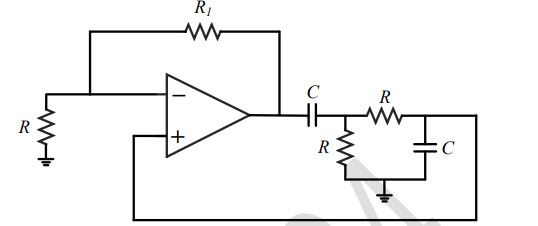
If the circuit is to show sustained oscillations, the respective values of $𝑅_1$ and the corresponding frequency of oscillation are _____.
To determine the conditions for sustained oscillations in the given circuit, we analyze the feedback network and apply the Barkhausen Criterion.
1. Identify the Feedback Network
The circuit consists of a non-inverting amplifier and an RC feedback network connected to the non-inverting terminal (\(+\)). The feedback network is a two-stage Lead-Lag network (common in Wien Bridge oscillators), consisting of:
- A series combination of capacitor \(C\) and a shunt resistor \(R\).
- Followed by a series resistor \(R\) and a shunt capacitor \(C\).
2. Calculate the Feedback Factor (\(\beta\))
The feedback factor \(\beta(s)\) is the transfer function from the output of the op-amp (\(V_{out}\)) to the non-inverting input (\(V_+\)). Using circuit analysis:
$$\beta(s) = \frac{V_+}{V_{out}} = \frac{1}{sRC + 3 + \frac{1}{sRC}}$$
Substituting \(s = j\omega\):
$$\beta(j\omega) = \frac{1}{3 + j\left(\omega RC - \frac{1}{\omega RC}\right)}$$
3. Apply the Barkhausen Criterion
For sustained oscillations, the loop gain must satisfy \(A\beta = 1\), where \(A\) is the gain of the non-inverting amplifier. This requires two conditions:
- Phase Condition: The phase shift of the loop must be \(0^\circ\). This occurs when the imaginary part of the denominator of \(\beta(j\omega)\) is zero: $$\omega RC - \frac{1}{\omega RC} = 0 \implies \omega^2 = \frac{1}{(RC)^2} \implies \omega = \frac{1}{RC}$$ The frequency of oscillation is: $$f = \frac{\omega}{2\pi} = \frac{1}{2\pi RC}$$
- Magnitude Condition: At this frequency, \(\beta = \frac{1}{3}\). Thus, we need a gain \(A = 3\). For a non-inverting amplifier: $$A = 1 + \frac{R_f}{R_{in}} = 1 + \frac{R_1}{R}$$ Setting the gain to 3: $$1 + \frac{R_1}{R} = 3 \implies \frac{R_1}{R} = 2 \implies R_1 = 2R$$
Conclusion
Based on the analysis, for sustained oscillations, the respective values are:
- Resistor \(R_1\): \(2R\)
- Frequency of oscillation: \(1/(2\pi RC)\)
The correct option is \(2R\) and \(1/(2\pi RC)\).
Important Questions from Oscillators and Feedback Amplifier
A relaxation oscillator is one which:
- A crystal has a thickness of 10 mm. If the thickness is reduced by 2%, the frequency of oscillations will _________.
In a phase shift oscillator, the frequency determining elements are _____.
- A relaxation oscillator produces
In a voltage series feedback amplifier, if R iis the input resistance without feedback. then input resistance with feedback is:


