
The correct relation between the radius of curvature R and focal length f of a spherical mirror is
R = 2f
Understanding Spherical Mirrors and Their Properties
A spherical mirror is a reflecting surface that is part of a sphere. Spherical mirrors are commonly used in various optical instruments. Key terms associated with spherical mirrors are:
- Pole (P): The center of the reflecting surface of the spherical mirror.
- Center of Curvature (C): The center of the sphere of which the mirror is a part.
- Radius of Curvature (R): The distance between the pole (P) and the center of curvature (C). This is the radius of the sphere from which the mirror is taken.
- Principal Axis: The straight line passing through the pole (P) and the center of curvature (C).
- Principal Focus (F): For a concave mirror, it is a point on the principal axis where rays of light parallel to the principal axis converge after reflection. For a convex mirror, it is a point on the principal axis from which rays of light parallel to the principal axis appear to diverge after reflection.
- Focal Length (f): The distance between the pole (P) and the principal focus (F).
Relationship Between Radius of Curvature and Focal Length
For spherical mirrors with a small aperture (meaning the mirror is a small part of the sphere, and we are considering paraxial rays, which are rays close to and parallel to the principal axis), there is a specific relationship between the radius of curvature (R) and the focal length (f).
The principal focus (F) of a spherical mirror is located exactly midway between the pole (P) and the center of curvature (C). This is a fundamental property derived from the laws of reflection for paraxial rays incident on a spherical surface.
Let's consider the distances:
- The distance between the pole (P) and the center of curvature (C) is the radius of curvature, denoted by \(R\). So, \(PC = R\).
- The distance between the pole (P) and the principal focus (F) is the focal length, denoted by \(f\). So, \(PF = f\).
Since the focus F is located midway between P and C, the distance PC is twice the distance PF. Mathematically, this can be written as:
\(PC = 2 \times PF\)
Substituting the definitions of R and f:
\(R = 2f\)
This relation holds true for both concave spherical mirrors and convex spherical mirrors under the paraxial approximation (small aperture).
Verifying the Options
Let's examine the given options based on the derived relation \(R = 2f\):
- \(R = f\) - This is incorrect. The radius of curvature is not equal to the focal length.
- \(R = 2f\) - This matches our derived relation. The radius of curvature is twice the focal length.
- \(R = 3f\) - This is incorrect. There is no such standard relation for spherical mirrors.
- \(R = 4f\) - This is incorrect. There is no such standard relation for spherical mirrors.
Therefore, the correct relation between the radius of curvature R and focal length f of a spherical mirror is \(R = 2f\).
Revision Table: Spherical Mirror Properties
| Property | Symbol | Description |
|---|---|---|
| Radius of Curvature | \(R\) | Distance from Pole to Center of Curvature |
| Focal Length | \(f\) | Distance from Pole to Principal Focus |
| Relation (for paraxial rays) | \(R = 2f\) | Radius of Curvature is twice the Focal Length |
Additional Information on Spherical Mirrors
The relation \(R = 2f\) is a good approximation for most practical spherical mirrors, especially when dealing with rays close to the principal axis. For rays far from the principal axis (non-paraxial rays), the reflected rays do not converge exactly at the principal focus, leading to a phenomenon called spherical aberration. Parabolic mirrors are used in applications like telescopes and satellite dishes to avoid spherical aberration, as they focus all parallel rays exactly at a single point regardless of how far they are from the axis.
Sign conventions are important when using mirror formulas. According to the New Cartesian Sign Convention, the pole (P) is taken as the origin, the principal axis as the x-axis, and distances are measured from the pole. Distances measured in the direction of incident light are taken as positive, and those measured in the opposite direction are taken as negative.
For a concave mirror, the focal length \(f\) and radius of curvature \(R\) are typically taken as negative because the focus and center of curvature are in front of the mirror (in the direction opposite to incident light, assuming light comes from the left). For a convex mirror, \(f\) and \(R\) are typically taken as positive because the focus and center of curvature are behind the mirror (in the direction of incident light).
Similar Questions
The image of an object formed by a plane mirror is
- An object is placed far beyond the centre of curvature of a concave mirror. The object then starts accelerating towards the mirror. Which one of the following is correct?
- It has been observed that a mirror always forms the image between the pole and the focus, irrespective of the location of the object. Which one of the following is correct in respect of the nature of the mirror?
The image we see in plane mirror is
According to the New Cartesian Sign Convention, which one of the following is correct is respect of the formula \(\dfrac{1}{f} = \dfrac{1}{v}+ \dfrac{1}{u}\) , where symbols have their usual meanings?
Which one of the following telescopes contains only mirrors?
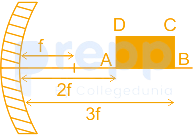
A rectangle ABCD is kept in front of a concave mirror of focal length f with its corners A and B being, respectively, at distances 2f and 3f from the mirror with AB along the principal axis as shown in the figure. It forms an image A'B'C'D' in front of the mirror. What is the ratio of B'C' to A'D'?
Spherical mirror formula relating an object distance ‘u’, image distance ‘v’ and focal length of mirror ‘f’ may be applied to a plane mirror when
Important Questions from Mirrors and Images
What type of mirror is used in the headlights of vehicles?
- A concave mirror forms a real and inverted image of a distant object at a distance of $15 \text{ cm}$ from the mirror.
If an object is placed $20 \text{ cm}$ in front of this mirror, what will be the nature and magnification of the image formed? The number of images observable between two parallel mirror is
An object is placed at a distance of \(\frac{f}{2}\) from a convex lens. The image will be
Which of the following pair is correct?
I. Mirror formula : (1/v) – (1/u) = (1/f)
II. Lens formula : (1/v) + (1/u) = (1/f)



