
Which one of the following telescopes contains only mirrors?
Newtonian telescope
Understanding Telescope Types and Their Components
Telescopes are powerful instruments used to observe distant objects by collecting and focusing light. They primarily use lenses or mirrors to achieve this. The question asks to identify which of the given telescopes uses only mirrors.
Exploring Different Telescope Designs
Let's look at the components used in each type of telescope mentioned in the options:
- Galilean telescope: This is a type of refracting telescope. It uses two lenses: a convex lens as the objective (the lens that collects light from the distant object) and a concave lens as the eyepiece (the lens you look through). Refracting telescopes bend light using lenses.
- Keplerian telescope: Also a type of refracting telescope. It uses two convex lenses: a convex lens as the objective and a convex lens as the eyepiece. Like the Galilean telescope, it relies on lenses to refract light.
- Newtonian telescope: This is a type of reflecting telescope. Invented by Sir Isaac Newton, it uses mirrors to reflect light. It has a primary mirror (usually parabolic) at the bottom of the tube which collects and focuses light towards a secondary mirror (usually flat) placed near the top of the tube. This secondary mirror then reflects the light out to the side, where the eyepiece is located. This design uses only mirrors for the primary light collection and focusing.
- Schmidt telescope: This design is a type of catadioptric telescope, meaning it uses both lenses and mirrors. A standard Schmidt camera or telescope uses a spherical primary mirror and a specially shaped lens element called a Schmidt corrector plate at the front of the tube. This corrector plate is designed to correct for the spherical aberration introduced by the spherical primary mirror. Some variants, like the Schmidt-Cassegrain, also include a secondary mirror, but they always include the corrector plate. Therefore, a Schmidt telescope does not use only mirrors.
Comparing Telescope Components
Let's summarize the primary optical components of each telescope type:
| Telescope Type | Objective | Eyepiece | Intermediate/Other Optics | Uses Only Mirrors? |
|---|---|---|---|---|
| Galilean | Lens (Convex) | Lens (Concave) | None | No |
| Keplerian | Lens (Convex) | Lens (Convex) | None | No |
| Newtonian | Mirror (Parabolic) | Lens | Secondary Mirror (Flat) | Yes (for light collection/focusing before eyepiece) |
| Schmidt | Mirror (Spherical) | Lens | Corrector Plate (Lens-like), sometimes Secondary Mirror | No |
Based on this comparison, the Newtonian telescope is the one among the options that uses only mirrors (a primary and a secondary mirror) for gathering and focusing light before it reaches the eyepiece (which is typically a lens, but the question asks about the telescope's main light-manipulating elements, where the distinction between reflecting and refracting applies).
Identifying the Mirror-Only Telescope
The Newtonian telescope design relies entirely on reflection from mirrors (primary and secondary) to form the image. This contrasts with Galilean and Keplerian telescopes, which use lenses (refraction), and Schmidt telescopes, which use a combination of mirrors and lenses (catadioptric). Therefore, the Newtonian telescope is the correct answer as it contains only mirrors in its light collection and focusing path, besides the eyepiece itself which is a separate component for viewing.
Revision Table: Key Telescope Types
| Telescope Type | Classification | Key Optical Components |
|---|---|---|
| Galilean | Refractor | Convex Objective Lens, Concave Eyepiece Lens |
| Keplerian | Refractor | Convex Objective Lens, Convex Eyepiece Lens |
| Newtonian | Reflector | Primary Mirror, Secondary Mirror |
| Schmidt | Catadioptric | Primary Mirror, Corrector Plate, Eyepiece Lens (often), possibly Secondary Mirror |
Additional Information on Telescope Optics
Understanding the difference between refractors and reflectors is fundamental in astronomy. Refractors use lenses, while reflectors use mirrors. Mirrors are generally easier to manufacture in large sizes without defects like chromatic aberration (color fringing), which is a common issue in lenses.
- Refractors: These telescopes bend light using lenses. They provide sharp, high-contrast images but can suffer from chromatic aberration and become very long for large apertures. Examples include Galilean and Keplerian designs.
- Reflectors: These telescopes bounce light off mirrors. They are generally less expensive to build for large apertures and do not suffer from chromatic aberration. The primary mirror collects light, and one or more secondary mirrors direct the light to the eyepiece. The Newtonian is a classic example.
- Catadioptric Telescopes: These combine both lenses and mirrors to achieve specific advantages, such as compact size or correction of aberrations. The Schmidt telescope is one example; another is the Schmidt-Cassegrain telescope, which uses a primary mirror, a secondary mirror, and a corrector plate.
The Newtonian design is a pure reflecting telescope using only mirrors to form the initial image, making it distinct from the other types listed in this specific regard of using only mirrors in the main light path.
Similar Questions
The image of an object formed by a plane mirror is
- An object is placed far beyond the centre of curvature of a concave mirror. The object then starts accelerating towards the mirror. Which one of the following is correct?
- It has been observed that a mirror always forms the image between the pole and the focus, irrespective of the location of the object. Which one of the following is correct in respect of the nature of the mirror?
The correct relation between the radius of curvature R and focal length f of a spherical mirror is
The image we see in plane mirror is
According to the New Cartesian Sign Convention, which one of the following is correct is respect of the formula \(\dfrac{1}{f} = \dfrac{1}{v}+ \dfrac{1}{u}\) , where symbols have their usual meanings?
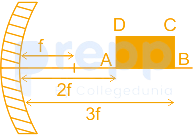
A rectangle ABCD is kept in front of a concave mirror of focal length f with its corners A and B being, respectively, at distances 2f and 3f from the mirror with AB along the principal axis as shown in the figure. It forms an image A'B'C'D' in front of the mirror. What is the ratio of B'C' to A'D'?
Spherical mirror formula relating an object distance ‘u’, image distance ‘v’ and focal length of mirror ‘f’ may be applied to a plane mirror when
Important Questions from Mirrors and Images
- A concave mirror forms a real and inverted image of a distant object at a distance of $15 \text{ cm}$ from the mirror.
If an object is placed $20 \text{ cm}$ in front of this mirror, what will be the nature and magnification of the image formed? The number of images observable between two parallel mirror is
Which of the following pair is correct?
I. Mirror formula : (1/v) – (1/u) = (1/f)
II. Lens formula : (1/v) + (1/u) = (1/f)
- A beam of parallel light, originating from a distant source, is first incident on a convex lens with focal length $f_2$.
Subsequently, the light passes through the lens and then reflects from a concave mirror having a focal length $f_1$.
The concave mirror is placed at a distance $d$ from the convex lens.
For the light rays to retrace their original path and ultimately emerge from the lens as a parallel beam heading back towards the distant source, the separation distance $d$ between the lens and the mirror must be: A ray of light is made incident on a concave mirror, parallel to its principal axis. After reflection it will -



