
Spherical mirror formula relating an object distance ‘u’, image distance ‘v’ and focal length of mirror ‘f’ may be applied to a plane mirror when
focal length goes to infinity.
Applying Spherical Mirror Formula to a Plane Mirror
The spherical mirror formula is a fundamental equation in optics that relates the object distance ($u$), image distance ($v$), and focal length ($f$) of a spherical mirror. The formula is given by:
$$\frac{1}{v} + \frac{1}{u} = \frac{1}{f}$$
Here, according to the standard sign conventions:
- $u$ is the object distance from the mirror. It is typically negative for a real object placed in front of the mirror.
- $v$ is the image distance from the mirror. It is positive for a virtual image behind the mirror and negative for a real image in front of the mirror.
- $f$ is the focal length of the mirror. It is negative for a concave mirror and positive for a convex mirror.
Characteristics of a Plane Mirror
A plane mirror can be considered a special case of a spherical mirror. A plane mirror always forms a virtual, erect, and same-sized image located behind the mirror at the same distance as the object is in front.
For a plane mirror, if a real object is placed at a distance $|u|$ in front of the mirror, a virtual image is formed at a distance $|v|$ behind the mirror. Using the standard sign convention (where the direction of incident light is positive), if the object is placed in front (left) of the mirror, $u$ is negative. The virtual image is formed behind (right) the mirror, so $v$ is positive.
The key characteristic is that the distance of the image behind the plane mirror is equal to the distance of the object in front of it. So, the magnitudes are equal: $|v| = |u|$. With sign convention, for a real object ($u \lt 0$), the virtual image is formed such that $v = -u$.
Applying the Spherical Mirror Formula to a Plane Mirror
Let's substitute the condition for a plane mirror ($v = -u$) into the spherical mirror formula:
$$\frac{1}{v} + \frac{1}{u} = \frac{1}{f}$$
Substitute $v = -u$ into the equation:
$$\frac{1}{(-u)} + \frac{1}{u} = \frac{1}{f}$$
This simplifies to:
$$-\frac{1}{u} + \frac{1}{u} = \frac{1}{f}$$
$$0 = \frac{1}{f}$$
For $\frac{1}{f}$ to be equal to zero, the value of $f$ must tend towards infinity ($f \to \infty$).
Therefore, the spherical mirror formula can be applied to a plane mirror when the focal length of the mirror goes to infinity.
Analysis of Given Options
Let's examine the provided options based on our derivation:
- focal length goes to infinity: As derived above, this condition leads to $\frac{1}{f} = 0$, which satisfies the relationship $\frac{1}{v} + \frac{1}{u} = 0$ for a plane mirror where $v = -u$. This is the correct condition.
- focal length goes to zero: If $f = 0$, the formula becomes $\frac{1}{v} + \frac{1}{u} = \frac{1}{0}$, which implies $\frac{1}{v} + \frac{1}{u} = \infty$. This condition does not describe a plane mirror.
- image distance goes to zero: If $v = 0$, the image is formed at the mirror surface. According to the formula $\frac{1}{0} + \frac{1}{u} = \frac{1}{f}$, which is undefined or implies $\frac{1}{u} = \frac{1}{f} - \infty$, not applicable to a plane mirror's general behavior. An image at the mirror surface typically only happens if the object is also at the surface ($u=0$), which is a singular point, not a general property.
- image distance goes to infinity: If $v \to \infty$, the formula $\frac{1}{\infty} + \frac{1}{u} = \frac{1}{f}$ becomes $0 + \frac{1}{u} = \frac{1}{f}$, or $\frac{1}{u} = \frac{1}{f}$. This means $u=f$. This condition describes an object placed at the focal point of a spherical mirror, forming an image at infinity, which is not characteristic of a plane mirror.
Based on this analysis, the only condition under which the spherical mirror formula applies to a plane mirror is when the focal length approaches infinity.
| Mirror Type | Focal Length (f) | Radius of Curvature (R) | Relationship between u and v | Condition in Formula $\frac{1}{v} + \frac{1}{u} = \frac{1}{f}$ |
|---|---|---|---|---|
| Spherical Mirror | Finite value (R/2) | Finite value | Varies based on u and f | $\frac{1}{v} + \frac{1}{u} = \frac{1}{f}$ |
| Plane Mirror | Infinity ($\infty$) | Infinity ($\infty$) | $v = -u$ (for real object) | $\frac{1}{v} + \frac{1}{u} = \frac{1}{\infty} = 0$ |
The table above summarizes the characteristics, highlighting how a plane mirror fits into the spherical mirror framework when considering infinite focal length and radius of curvature.
Revision Table: Spherical vs. Plane Mirrors
| Feature | Spherical Mirror | Plane Mirror |
|---|---|---|
| Shape | Part of a sphere | Flat surface |
| Focal Length (f) | Finite (R/2) | Infinite ($\infty$) |
| Radius of Curvature (R) | Finite (2f) | Infinite ($\infty$) |
| Image Type (for real object) | Real or Virtual | Always Virtual |
| Image Size | Magnified, Diminished, or Same Size | Same size as object |
| Image Orientation | Inverted (for real image), Erect (for virtual image) | Always Erect |
| Image Location (for real object) | Varies with object distance | Behind mirror, same distance as object in front ($|v|=|u|$) |
Additional Information: Radius of Curvature of a Plane Mirror
The focal length ($f$) of a spherical mirror is related to its radius of curvature ($R$) by the formula $f = R/2$. Since a plane mirror can be considered a spherical mirror with an infinite focal length, its radius of curvature must also be infinite.
Imagine a sphere with a very large radius. As the radius increases, the surface of the sphere becomes flatter and flatter. In the limit as the radius approaches infinity, a small section of the sphere's surface becomes essentially flat, resembling a plane. Thus, a plane mirror has an infinite radius of curvature, which corresponds to an infinite focal length.
The relationship between object and image distances for a plane mirror, $v = -u$ (with signs), is a direct consequence of its geometry, and it fits consistently with the spherical mirror formula when $f = \infty$, leading to $\frac{1}{v} + \frac{1}{u} = \frac{1}{\infty} = 0$.
Similar Questions
The image of an object formed by a plane mirror is
- An object is placed far beyond the centre of curvature of a concave mirror. The object then starts accelerating towards the mirror. Which one of the following is correct?
- It has been observed that a mirror always forms the image between the pole and the focus, irrespective of the location of the object. Which one of the following is correct in respect of the nature of the mirror?
The correct relation between the radius of curvature R and focal length f of a spherical mirror is
The image we see in plane mirror is
According to the New Cartesian Sign Convention, which one of the following is correct is respect of the formula \(\dfrac{1}{f} = \dfrac{1}{v}+ \dfrac{1}{u}\) , where symbols have their usual meanings?
Which one of the following telescopes contains only mirrors?
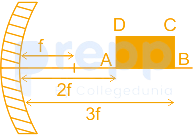
A rectangle ABCD is kept in front of a concave mirror of focal length f with its corners A and B being, respectively, at distances 2f and 3f from the mirror with AB along the principal axis as shown in the figure. It forms an image A'B'C'D' in front of the mirror. What is the ratio of B'C' to A'D'?
Important Questions from Mirrors and Images
What type of mirror is used in the headlights of vehicles?
- A concave mirror forms a real and inverted image of a distant object at a distance of $15 \text{ cm}$ from the mirror.
If an object is placed $20 \text{ cm}$ in front of this mirror, what will be the nature and magnification of the image formed? The number of images observable between two parallel mirror is
An object is placed at a distance of \(\frac{f}{2}\) from a convex lens. The image will be
Which of the following pair is correct?
I. Mirror formula : (1/v) – (1/u) = (1/f)
II. Lens formula : (1/v) + (1/u) = (1/f)



