
According to the New Cartesian Sign Convention, which one of the following is correct is respect of the formula \(\dfrac{1}{f} = \dfrac{1}{v}+ \dfrac{1}{u}\) , where symbols have their usual meanings?
It applies only to spherical mirrors
Understanding the Mirror Formula and Lens Formula
The question asks about the applicability of the formula \(\dfrac{1}{f} = \dfrac{1}{v}+ \dfrac{1}{u}\) according to the New Cartesian Sign Convention, where \(f\) is the focal length, \(v\) is the image distance, and \(u\) is the object distance. This specific formula is fundamental in the study of optics and relates these three quantities for a particular type of optical device.
In optics, we use different formulas to describe the relationship between object distance, image distance, and focal length for spherical mirrors and spherical lenses. The formula provided is a key equation used for calculating distances in relation to spherical mirrors.
Analyzing the Given Formula: \(\dfrac{1}{f} = \dfrac{1}{v}+ \dfrac{1}{u}\)
The formula \(\dfrac{1}{f} = \dfrac{1}{v}+ \dfrac{1}{u}\) is universally known as the mirror formula. It is used to calculate the position of the image (\(v\)) formed by a spherical mirror (either concave or convex) when the object distance (\(u\)) and the focal length (\(f\)) are known, or to find any one of these quantities if the other two are known. This formula is derived based on the laws of reflection and geometry for spherical mirrors.
Comparing with the Lens Formula
For spherical lenses (either convex or concave), the relationship between \(u\), \(v\), and \(f\) is given by a slightly different formula, known as the lens formula. The lens formula is:
\( \dfrac{1}{f} = \dfrac{1}{v} - \dfrac{1}{u} \)
Notice the difference in the sign before the \(\dfrac{1}{u}\) term. The mirror formula has a plus sign (\(+\)), while the lens formula has a minus sign (\(-\)). This difference arises because mirrors form images through reflection, whereas lenses form images through refraction.
Role of the New Cartesian Sign Convention
The New Cartesian Sign Convention is a set of rules used consistently in ray diagrams and calculations for both spherical mirrors and spherical lenses. It establishes how to assign positive or negative signs to the distances \(u\), \(v\), and \(f\). The convention states:
- All distances are measured from the optical centre of the lens or the pole of the mirror.
- Distances measured in the direction of incident light are taken as positive.
- Distances measured in the direction opposite to the direction of incident light are taken as negative.
- Heights measured upwards and perpendicular to the principal axis are taken as positive.
- Heights measured downwards and perpendicular to the principal axis are taken as negative.
While the New Cartesian Sign Convention is applied when using both the mirror formula and the lens formula to ensure the signs of \(u\), \(v\), and \(f\) are correct according to the position of the object and image, the formula itself (\(\dfrac{1}{f} = \dfrac{1}{v}+ \dfrac{1}{u}\)) is specific to spherical mirrors. The convention helps in using the correct formula with appropriate signs, but it does not change the formula itself or make the mirror formula applicable to lenses.
Conclusion
Based on the standard formulas used in optics, the equation \(\dfrac{1}{f} = \dfrac{1}{v}+ \dfrac{1}{u}\) is the formula that applies specifically to spherical mirrors. The lens formula has a different structure (\(\dfrac{1}{f} = \dfrac{1}{v} - \dfrac{1}{u}\)). Therefore, the given formula is correct only for spherical mirrors.
Let's look at the options again:
- It applies only to spherical mirrors
- It applies only to spherical lenses
- It applies to spherical mirrors as well as spherical lenses
- It is an invalid formula
As discussed, the formula \(\dfrac{1}{f} = \dfrac{1}{v}+ \dfrac{1}{u}\) is the standard mirror formula. It does not apply to spherical lenses. Hence, the statement that it applies only to spherical mirrors is correct.
Revision Table: Optical Formulas
| Optical Device | Formula Relating \(u\), \(v\), \(f\) |
|---|---|
| Spherical Mirrors | \( \dfrac{1}{f} = \dfrac{1}{v}+ \dfrac{1}{u} \) (Mirror Formula) |
| Spherical Lenses | \( \dfrac{1}{f} = \dfrac{1}{v} - \dfrac{1}{u} \) (Lens Formula) |
Additional Information: Spherical Mirror Properties
Spherical mirrors are reflective surfaces shaped like a part of a sphere. They are primarily of two types:
- Concave Mirror: A converging mirror where the reflective surface is curved inwards. It can form both real and virtual images, depending on the object's position.
- Convex Mirror: A diverging mirror where the reflective surface is curved outwards. It always forms virtual, erect, and diminished images.
The mirror formula \(\dfrac{1}{f} = \dfrac{1}{v}+ \dfrac{1}{u}\) is applicable to both concave and convex mirrors when the New Cartesian Sign Convention is used correctly to determine the signs of \(u\), \(v\), and \(f\).
Similar Questions
The image of an object formed by a plane mirror is
- An object is placed far beyond the centre of curvature of a concave mirror. The object then starts accelerating towards the mirror. Which one of the following is correct?
- It has been observed that a mirror always forms the image between the pole and the focus, irrespective of the location of the object. Which one of the following is correct in respect of the nature of the mirror?
The correct relation between the radius of curvature R and focal length f of a spherical mirror is
The image we see in plane mirror is
Which one of the following telescopes contains only mirrors?
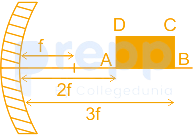
A rectangle ABCD is kept in front of a concave mirror of focal length f with its corners A and B being, respectively, at distances 2f and 3f from the mirror with AB along the principal axis as shown in the figure. It forms an image A'B'C'D' in front of the mirror. What is the ratio of B'C' to A'D'?
Spherical mirror formula relating an object distance ‘u’, image distance ‘v’ and focal length of mirror ‘f’ may be applied to a plane mirror when
Important Questions from Mirrors and Images
What type of mirror is used in the headlights of vehicles?
- A concave mirror forms a real and inverted image of a distant object at a distance of $15 \text{ cm}$ from the mirror.
If an object is placed $20 \text{ cm}$ in front of this mirror, what will be the nature and magnification of the image formed? The number of images observable between two parallel mirror is
An object is placed at a distance of \(\frac{f}{2}\) from a convex lens. The image will be
Which of the following pair is correct?
I. Mirror formula : (1/v) – (1/u) = (1/f)
II. Lens formula : (1/v) + (1/u) = (1/f)



