
The image will accelerate towards the centre of curvature.
To understand the behavior of an image formed by a concave mirror when the object accelerates towards the mirror, it's important to use the mirror formula and the properties of concave mirrors.
Mirror Formula: The mirror formula is given by:
\(\frac{1}{f} = \frac{1}{v} + \frac{1}{u}\)
Where:
- \(f\) is the focal length of the mirror.
- \(v\) is the image distance from the mirror.
- \(u\) is the object distance from the mirror.
Assuming the object starts beyond the center of curvature (which is 2f for a concave mirror) and moves towards the mirror, let's analyze the scenario with respect to the image:
- When the object is at a distance greater than twice the focal length (\(u > 2f\)), the image is formed between the focal point (\(f\)) and the center of curvature (\(2f\)).
- As the object moves closer to the mirror (decreasing \(u\)), the image distance \(v\) increases, and the image itself moves away from the mirror, between the center of curvature and beyond.
- Since the object is accelerating towards the mirror, the change in distance per unit time increases. Hence, the rate of change of the image’s position also increases. In other words, the image accelerates away from the focus towards the center of curvature.
Thus, based on this analysis, we can conclude that the image will indeed accelerate towards the center of curvature as the object accelerates towards the mirror.
Correct Answer: The image will accelerate towards the centre of curvature.
Similar Questions
The image of an object formed by a plane mirror is
- It has been observed that a mirror always forms the image between the pole and the focus, irrespective of the location of the object. Which one of the following is correct in respect of the nature of the mirror?
The correct relation between the radius of curvature R and focal length f of a spherical mirror is
The image we see in plane mirror is
According to the New Cartesian Sign Convention, which one of the following is correct is respect of the formula \(\dfrac{1}{f} = \dfrac{1}{v}+ \dfrac{1}{u}\) , where symbols have their usual meanings?
Which one of the following telescopes contains only mirrors?
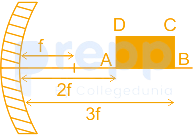
A rectangle ABCD is kept in front of a concave mirror of focal length f with its corners A and B being, respectively, at distances 2f and 3f from the mirror with AB along the principal axis as shown in the figure. It forms an image A'B'C'D' in front of the mirror. What is the ratio of B'C' to A'D'?
Spherical mirror formula relating an object distance ‘u’, image distance ‘v’ and focal length of mirror ‘f’ may be applied to a plane mirror when
Important Questions from Mirrors and Images
- A concave mirror forms a real and inverted image of a distant object at a distance of $15 \text{ cm}$ from the mirror.
If an object is placed $20 \text{ cm}$ in front of this mirror, what will be the nature and magnification of the image formed? The number of images observable between two parallel mirror is
Which of the following pair is correct?
I. Mirror formula : (1/v) – (1/u) = (1/f)
II. Lens formula : (1/v) + (1/u) = (1/f)
- A beam of parallel light, originating from a distant source, is first incident on a convex lens with focal length $f_2$.
Subsequently, the light passes through the lens and then reflects from a concave mirror having a focal length $f_1$.
The concave mirror is placed at a distance $d$ from the convex lens.
For the light rays to retrace their original path and ultimately emerge from the lens as a parallel beam heading back towards the distant source, the separation distance $d$ between the lens and the mirror must be: A ray of light is made incident on a concave mirror, parallel to its principal axis. After reflection it will -



