
The image of an object formed by a plane mirror is
erect, virtual and same size.
Understanding Images Formed by Plane Mirrors
A plane mirror is a flat, smooth surface that reflects light. When an object is placed in front of a plane mirror, an image is formed behind the mirror. The characteristics of this image are always specific and depend on the nature of the plane mirror itself.
Properties of the Image Formed by a Plane Mirror
Let's look at the common properties used to describe images formed by mirrors and lenses:
- Erect vs. Inverted: An erect image is one that is oriented the same way as the object (e.g., if the object is upright, the image is also upright). An inverted image is one that is upside down relative to the object.
- Real vs. Virtual: A real image is formed where light rays actually converge. It can be projected onto a screen. A virtual image is formed where light rays appear to diverge from. It cannot be projected onto a screen; it can only be seen when looking into the mirror or lens.
- Size: The size of the image can be larger than the object, smaller than the object, or the same size as the object.
- Lateral Inversion: This is a special property of images formed by plane mirrors. The image is laterally inverted, meaning the left side of the object appears as the right side in the image, and vice versa.
Detailed Explanation of Plane Mirror Image Characteristics
When considering a plane mirror, we observe the following characteristics for the image formed:
- The image is Erect: If you stand upright in front of a plane mirror, your image is also upright. Your head appears at the top, and your feet at the bottom, just like you.
- The image is Virtual: The light rays from the object do not actually meet behind the mirror to form the image. They only appear to come from a point behind the mirror. This is why you cannot project the image from a plane mirror onto a screen placed behind the mirror. You see the image by looking into the mirror.
- The image is the Same Size as the Object: The image formed by a plane mirror is neither magnified nor reduced. It is exactly the same height and width as the object.
- The image is Laterally Inverted: This is a unique characteristic. If you raise your right hand, your image in the mirror appears to raise its left hand.
- The image is located as far behind the mirror as the object is in front of it: The distance from the object to the mirror is equal to the distance from the image to the mirror.
Analyzing the Given Options
Let's evaluate each option based on the properties we just discussed:
- erect, real and larger.
This is incorrect. The image in a plane mirror is erect and virtual, not real. It is also the same size, not larger. - erect, virtual and same size.
This matches the characteristics we described: the image is erect, virtual, and the same size as the object. - inverted, virtual and same size.
This is incorrect. The image in a plane mirror is erect, not inverted. It is virtual and the same size, but the 'inverted' part makes this option wrong. - inverted, real and smaller.
This is incorrect. The image in a plane mirror is erect, not inverted. It is virtual, not real. It is the same size, not smaller.
Therefore, the image of an object formed by a plane mirror is erect, virtual, and the same size as the object.
| Property | Image in Plane Mirror |
|---|---|
| Orientation (compared to object) | Erect |
| Nature | Virtual |
| Size (compared to object) | Same Size |
| Lateral Inversion | Yes |
| Distance from Mirror | Same as object distance |
Revision Table: Key Plane Mirror Image Properties
| Key Property | Description for Plane Mirror |
|---|---|
| Nature | Virtual (cannot be projected) |
| Orientation | Erect (upright) |
| Size | Same size as the object |
| Laterally Inverted | Yes (left <--> right) |
| Image Distance | Equal to object distance |
Additional Information: Real vs. Virtual Images in Optics
Understanding the difference between real and virtual images is crucial in optics.
- Real Images:
- Formed by the actual convergence of light rays.
- Can be projected onto a screen.
- Often formed by concave mirrors (when the object is beyond the focal point) and convex lenses (when the object is beyond the focal point).
- Real images are typically inverted.
- Virtual Images:
- Formed where light rays appear to diverge from.
- Cannot be projected onto a screen.
- Formed by plane mirrors, convex mirrors, concave mirrors (when the object is within the focal point), and concave lenses.
- Virtual images are typically erect.
Plane mirrors consistently produce virtual and erect images of the same size, making them useful for everyday applications like grooming and reflective surfaces.
Similar Questions
- An object is placed far beyond the centre of curvature of a concave mirror. The object then starts accelerating towards the mirror. Which one of the following is correct?
- It has been observed that a mirror always forms the image between the pole and the focus, irrespective of the location of the object. Which one of the following is correct in respect of the nature of the mirror?
The correct relation between the radius of curvature R and focal length f of a spherical mirror is
The image we see in plane mirror is
According to the New Cartesian Sign Convention, which one of the following is correct is respect of the formula \(\dfrac{1}{f} = \dfrac{1}{v}+ \dfrac{1}{u}\) , where symbols have their usual meanings?
Which one of the following telescopes contains only mirrors?
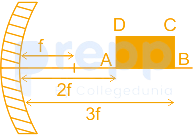
A rectangle ABCD is kept in front of a concave mirror of focal length f with its corners A and B being, respectively, at distances 2f and 3f from the mirror with AB along the principal axis as shown in the figure. It forms an image A'B'C'D' in front of the mirror. What is the ratio of B'C' to A'D'?
Spherical mirror formula relating an object distance ‘u’, image distance ‘v’ and focal length of mirror ‘f’ may be applied to a plane mirror when
Important Questions from Mirrors and Images
What type of mirror is used in the headlights of vehicles?
- A concave mirror forms a real and inverted image of a distant object at a distance of $15 \text{ cm}$ from the mirror.
If an object is placed $20 \text{ cm}$ in front of this mirror, what will be the nature and magnification of the image formed? The number of images observable between two parallel mirror is
An object is placed at a distance of \(\frac{f}{2}\) from a convex lens. The image will be
Which of the following pair is correct?
I. Mirror formula : (1/v) – (1/u) = (1/f)
II. Lens formula : (1/v) + (1/u) = (1/f)



