
The image we see in plane mirror is
virtual and is laterally inverted.
Understanding Images Formed by a Plane Mirror
When you look into a plane mirror, like the one you use every day, you see a reflection. This reflection is actually an image formed by the mirror. The properties of this image are distinct and follow specific rules of reflection.
Let's explore the characteristics of the image formed by a plane mirror:
- Virtual Image: The image formed by a plane mirror is virtual. This means that the light rays do not actually converge at the location of the image; they only appear to come from there. You cannot project a virtual image onto a screen.
- Erect Image: The image is upright, meaning it is not inverted vertically. If you stand upright in front of a plane mirror, your image will also be upright.
- Same Size: The image formed is the same size as the object.
- Same Distance: The image appears to be located behind the mirror at the same distance as the object is in front of the mirror.
- Laterally Inverted: This is a key characteristic. The image is flipped horizontally. Your left side appears as the right side of your image, and vice versa. This is why ambulance is often written in reverse on the front.
Analyzing the Image Characteristics of a Plane Mirror
Now let's evaluate the given options based on these properties:
- The image we see in plane mirror is real and thus can be photographed.
This statement is incorrect. As discussed, the image formed by a plane mirror is virtual, not real. While you can photograph a virtual image (your camera lens forms a real image on the film or sensor from the virtual image), the premise that the image itself is real is false.
- The image we see in plane mirror is virtual and nearer than the object.
This statement is incorrect. The image formed by a plane mirror is indeed virtual, but it is located at the same distance behind the mirror as the object is in front of the mirror, not nearer.
- The image we see in plane mirror is virtual and is laterally inverted.
This statement is correct. The image formed by a plane mirror is virtual and it exhibits lateral inversion, meaning it is reversed left to right.
- The image we see in plane mirror is real but cannot be photographed.
This statement is incorrect. The image is virtual, not real. Also, virtual images can generally be photographed by converging the rays with a lens (like a camera lens) to form a real image on the film or sensor.
Based on the analysis of the properties of images formed by plane mirrors, the statement that accurately describes the image is that it is virtual and laterally inverted.
| Image Property | Plane Mirror |
|---|---|
| Nature | Virtual |
| Orientation | Erect |
| Size | Same as object |
| Distance from mirror | Same as object distance |
| Inversion | Laterally inverted |
Revision Table: Key Facts on Plane Mirror Images
Here’s a quick summary of what we learned about the image from a plane mirror:
- The image is always virtual.
- The image is always erect (upright).
- The image size is equal to the object size.
- The image distance is equal to the object distance.
- The image is laterally inverted.
Additional Information: Real vs. Virtual Images
Understanding the difference between real and virtual images is fundamental in optics.
- Real Image: Formed when light rays actually converge at a point after reflection or refraction. Real images can be projected onto a screen. Examples include the image formed on a cinema screen or the image formed by a convex lens on a screen in a lab.
- Virtual Image: Formed when light rays only appear to diverge from a point after reflection or refraction. The rays do not actually converge. Virtual images cannot be projected onto a screen. Examples include the image in a plane mirror or the image formed by a concave lens.
The ability to photograph an image depends on whether a lens can converge the light rays to form a real image on the camera's sensor. A camera lens does this, allowing us to photograph both real objects and the virtual images formed by mirrors and lenses.
Similar Questions
The image of an object formed by a plane mirror is
- An object is placed far beyond the centre of curvature of a concave mirror. The object then starts accelerating towards the mirror. Which one of the following is correct?
- It has been observed that a mirror always forms the image between the pole and the focus, irrespective of the location of the object. Which one of the following is correct in respect of the nature of the mirror?
The correct relation between the radius of curvature R and focal length f of a spherical mirror is
According to the New Cartesian Sign Convention, which one of the following is correct is respect of the formula \(\dfrac{1}{f} = \dfrac{1}{v}+ \dfrac{1}{u}\) , where symbols have their usual meanings?
Which one of the following telescopes contains only mirrors?
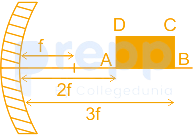
A rectangle ABCD is kept in front of a concave mirror of focal length f with its corners A and B being, respectively, at distances 2f and 3f from the mirror with AB along the principal axis as shown in the figure. It forms an image A'B'C'D' in front of the mirror. What is the ratio of B'C' to A'D'?
Spherical mirror formula relating an object distance ‘u’, image distance ‘v’ and focal length of mirror ‘f’ may be applied to a plane mirror when
Important Questions from Mirrors and Images
- A concave mirror forms a real and inverted image of a distant object at a distance of $15 \text{ cm}$ from the mirror.
If an object is placed $20 \text{ cm}$ in front of this mirror, what will be the nature and magnification of the image formed? The number of images observable between two parallel mirror is
Which of the following pair is correct?
I. Mirror formula : (1/v) – (1/u) = (1/f)
II. Lens formula : (1/v) + (1/u) = (1/f)
- A beam of parallel light, originating from a distant source, is first incident on a convex lens with focal length $f_2$.
Subsequently, the light passes through the lens and then reflects from a concave mirror having a focal length $f_1$.
The concave mirror is placed at a distance $d$ from the convex lens.
For the light rays to retrace their original path and ultimately emerge from the lens as a parallel beam heading back towards the distant source, the separation distance $d$ between the lens and the mirror must be: A ray of light is made incident on a concave mirror, parallel to its principal axis. After reflection it will -



