
The circuit shown below, will act as an ideal current source with respect to terminals A and B when frequency is :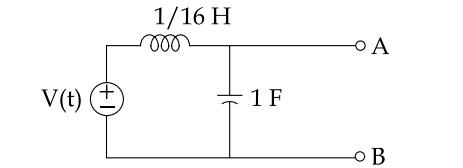
4 rad/sec
What makes a source "ideal" as a current source. A practical source is a Norton equivalent — a current source with a shunt output impedance. It approaches the ideal current source when that output impedance becomes infinite, so that the current delivered is independent of whatever load is connected:
\(Z_{out}\to\infty\)
So the question is really: at what frequency does the impedance seen at A–B become infinite?
Step 1 — find the output impedance. Kill the independent source by shorting it. Looking back into A–B, the capacitor sits directly across the terminals, and the inductor also reaches those terminals through the short. The two are therefore in parallel:
\(Z_{out}=\dfrac{Z_LZ_C}{Z_L+Z_C}=\dfrac{(j\omega L)\left(\dfrac{1}{j\omega C}\right)}{j\omega L+\dfrac{1}{j\omega C}}=\dfrac{j\omega L}{1-\omega^{2}LC}\)
Step 2 — make it infinite. The denominator must vanish:
\(1-\omega^{2}LC=0 \quad\Longrightarrow\quad \omega_0=\dfrac{1}{\sqrt{LC}}\)
This is parallel resonance — the inductive and capacitive currents are equal and opposite, they circulate entirely within the LC loop, and none is drawn from outside. An ideal parallel LC at resonance is an open circuit.
Step 3 — substitute the values.
\(\omega_0=\dfrac{1}{\sqrt{\left(\tfrac{1}{16}\right)(1)}}=\dfrac{1}{\tfrac{1}{4}}=4\ \text{rad/s}\)
which is option 4.
Where the distractors come from. Option 3, 16 rad/s, is what you get by forgetting the square root — that is \(1/LC\), which has the units of ω2, not ω. Option 1 would need LC = 1. Option 2, ω = 0, is the DC case, where the inductor is a short and the capacitor an open — the output impedance is then zero, which is the condition for an ideal voltage source, the exact opposite of what is asked.
The dual worth remembering. Series resonance makes the impedance minimum (a short at the terminals) and so approximates an ideal voltage source; parallel resonance makes it maximum and so approximates an ideal current source. Both occur at the same \(1/\sqrt{LC}\) — it is the topology, not the frequency, that decides which behaviour appears.
Hence, the circuit acts as an ideal current source at 4 rad/sec.
Similar Questions
In a parallel RLC circuit shown in figure at resonance
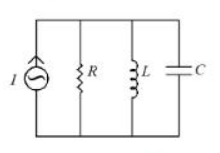
A. Current I flows through the resistor
B. Total current flowing through LC combination is zero
C. Current flows in the inductor is zero
D. total current flowing through LC combination is 2 A
E. Current flows in the capacitor is zero
Choose the most appropriate answer from the options given below :
Important Questions from Electrical Resonance
The lower and upper cut-off frequencies are also called as _______ frequencies.
In RLC series circuit under variable frequency, what is initially negative and becomes zero and then positive?
Which of the following is NOT the property of a parallel resonant RLC circuit?
A tuned amplifier has a voltage gain of 100 and a bandwidth of 10 KHz at 500 KHz. It is required to increase the bandwidth to 20 KHz. This can be achieved by which one of the following ways?
Consider the following statements and choose the correct answer:
Statement 1: In an RLC series circuit, at half-power frequencies the magnitude of total reactance is equal to resistance.
Statement 2: In an RLC parallel circuit, at half-power frequencies the magnitude total susceptance is equal to conductance.



