
Consider the following statements and choose the correct answer: Statement 1: In an RLC series circuit, at half-power frequencies the magnitude of total reactance is equal to resistance. Statement 2: In an RLC parallel circuit, at half-power frequencies the magnitude total susceptance is equal to conductance.
Both Statement 1 and Statement 2 are TRUE
RLC Circuit Analysis at Half-Power Frequencies
Let's analyze each statement regarding RLC circuits at half-power frequencies.
Statement 1: RLC Series Circuit Half-Power Frequency
In a series RLC circuit, the impedance is given by \(Z = R + jX\), where \(R\) is the resistance and \(X = \omega L - \frac{1}{\omega C}\) is the reactance. The magnitude of impedance is \(|Z| = \sqrt{R^2 + X^2}\).
The power dissipated in the circuit is \(P = \frac{V^2 R}{|Z|^2}\), where \(V\) is the RMS voltage across the circuit. At resonance (\(\omega_0\)), the reactance \(X=0\), so \(|Z| = R\), and the power is maximum, \(P_{max} = \frac{V^2}{R}\).
Half-power frequencies (\(\omega_l\) and \(\omega_h\)) are the frequencies where the power is half of the maximum power: \(P = \frac{P_{max}}{2}\).
So, \(\frac{V^2 R}{|Z|^2} = \frac{1}{2} \frac{V^2}{R}\).
This simplifies to \(|Z|^2 = 2R^2\), which means \(|Z| = \sqrt{2}R\).
Substituting the expression for \(|Z|\):
\(\sqrt{R^2 + X^2} = \sqrt{2}R\)
\(R^2 + X^2 = 2R^2\)
\(X^2 = R^2\)
\(|X| = R\)
Thus, at half-power frequencies in a series RLC circuit, the magnitude of the total reactance is equal to the resistance. Statement 1 is TRUE.
Statement 2: RLC Parallel Circuit Half-Power Frequency
In a parallel RLC circuit driven by a voltage source, it's convenient to use admittance, \(Y = G + jB\), where \(G = \frac{1}{R}\) is the conductance and \(B = \omega C - \frac{1}{\omega L}\) is the total susceptance. The magnitude of admittance is \(|Y| = \sqrt{G^2 + B^2}\).
For a voltage source V across the parallel combination, the current drawn is \(I = VY\). The power dissipated in the resistor is \(P = \frac{V^2}{R} = V^2 G\). Note that this power is constant if V is constant.
The concept of half-power frequencies in a parallel RLC circuit (driven by a voltage source) usually refers to the frequencies where the magnitude of the current drawn from the source is \(\sqrt{2}\) times the minimum current drawn at resonance.
At resonance (\(\omega_0\)), the susceptance \(B=0\), so \(|Y| = G\), and the current magnitude is minimum, \(|I_{min}| = V|Y| = VG\).
At half-power frequencies, \(|I| = \sqrt{2} |I_{min}|\).
So, \(V|Y| = \sqrt{2} VG\), which means \(|Y| = \sqrt{2}G\).
Substituting the expression for \(|Y|\):
\(\sqrt{G^2 + B^2} = \sqrt{2}G\)
\(G^2 + B^2 = 2G^2\)
\(B^2 = G^2\)
\(|B| = G\)
Thus, at half-power frequencies in a parallel RLC circuit, the magnitude of the total susceptance is equal to the conductance. Statement 2 is TRUE.
Conclusion
Based on the analysis of both statements, Statement 1 is TRUE and Statement 2 is TRUE.
Therefore, the correct answer is that both Statement 1 and Statement 2 are TRUE.
Important Questions from Electrical Resonance
The lower and upper cut-off frequencies are also called as _______ frequencies.
The circuit shown below, will act as an ideal current source with respect to terminals A and B when frequency is :
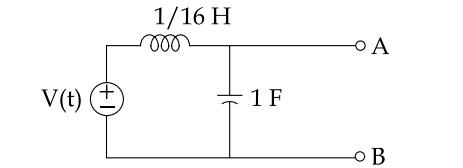
In RLC series circuit under variable frequency, what is initially negative and becomes zero and then positive?
Which of the following is NOT the property of a parallel resonant RLC circuit?
A tuned amplifier has a voltage gain of 100 and a bandwidth of 10 KHz at 500 KHz. It is required to increase the bandwidth to 20 KHz. This can be achieved by which one of the following ways?


