
A tuned amplifier has a voltage gain of 100 and a bandwidth of 10 KHz at 500 KHz. It is required to increase the bandwidth to 20 KHz. This can be achieved by which one of the following ways?
by halving the Q of the coil
Tuned Amplifier Bandwidth Enhancement
A tuned amplifier is specifically designed to amplify signals within a narrow range of frequencies, often used in radio receivers and transmitters. Its performance is critically defined by several interconnected parameters: voltage gain, resonant frequency, bandwidth, and the quality factor (Q factor) of its resonant circuit.
Tuned Amplifier Parameters Explained
- Voltage Gain: This measures how much the amplifier increases the input signal voltage. For the given amplifier, the initial voltage gain is 100.
- Resonant Frequency (\(f_r\)): This is the central frequency at which the tuned amplifier provides its maximum amplification. In this case, the resonant frequency is 500 KHz.
- Bandwidth (BW): This represents the range of frequencies over which the amplifier's gain remains at or above 70.7% (or \(\frac{1}{\sqrt{2}}\)) of its maximum gain. Initially, the amplifier has a bandwidth of 10 KHz.
- Quality Factor (Q factor): This parameter quantifies the selectivity of the tuned circuit within the amplifier. A higher Q factor indicates a more selective circuit, resulting in a narrower bandwidth. Conversely, a lower Q factor means less selectivity and a wider bandwidth. It is a fundamental determinant of a tuned amplifier's bandwidth.
Bandwidth and Q Factor Relationship
The bandwidth (BW) of a tuned amplifier is directly proportional to its resonant frequency (\(f_r\)) and inversely proportional to its quality factor (Q). This crucial relationship is expressed by the formula:
\[ \text{BW} = \frac{f_r}{Q} \]From this formula, it is evident that to increase the bandwidth (BW) while keeping the resonant frequency (\(f_r\)) constant, the quality factor (Q) must be decreased.
Tuned Amplifier Initial State
Let's analyze the given initial parameters of the tuned amplifier:
- Initial Bandwidth (\(\text{BW}_1\)) = 10 KHz
- Resonant Frequency (\(f_r\)) = 500 KHz
Using the formula, we can calculate the initial Q factor (\(\text{Q}_1\)) of the amplifier's tuned circuit:
\[ \text{Q}_1 = \frac{f_r}{\text{BW}_1} = \frac{500 \text{ KHz}}{10 \text{ KHz}} = 50 \]| Parameter | Initial Value | Target Value |
|---|---|---|
| Bandwidth (BW) | 10 KHz | 20 KHz |
| Resonant Frequency (\(f_r\)) | 500 KHz | 500 KHz (assumed constant for this adjustment) |
| Q Factor (Q) | 50 | ? |
Desired Bandwidth Achievement (20 KHz)
The objective is to increase the bandwidth to 20 KHz. Let the target bandwidth be \(\text{BW}_2 = 20 \text{ KHz}\). Assuming the resonant frequency remains at 500 KHz, we need to determine the new Q factor (\(\text{Q}_2\)) required to achieve this wider bandwidth:
\[ \text{Q}_2 = \frac{f_r}{\text{BW}_2} = \frac{500 \text{ KHz}}{20 \text{ KHz}} = 25 \]By comparing the initial Q factor (\(\text{Q}_1 = 50\)) with the calculated new Q factor (\(\text{Q}_2 = 25\)), we can see that \(\text{Q}_2 = \frac{\text{Q}_1}{2}\). This clearly indicates that the Q factor of the coil needs to be halved to double the bandwidth.
Bandwidth Increase Options Evaluation
Let's evaluate the given options in the context of increasing the amplifier's bandwidth:
- By doubling the gain: Increasing the voltage gain of a tuned amplifier typically leads to a reduction in its bandwidth, not an increase. This is because for many amplifier designs, the gain-bandwidth product tends to be constant. Moreover, the Q factor of the tuned circuit is not directly altered by simply changing the amplifier's gain.
- By doubling the resonant frequency: If the resonant frequency were doubled to 1000 KHz while the Q factor remained at 50, the bandwidth would indeed become \(\text{BW} = \frac{1000 \text{ KHz}}{50} = 20 \text{ KHz}\). While this mathematically achieves the desired bandwidth, it fundamentally shifts the amplifier's operating center frequency, which might not be the intended adjustment. The question seeks a direct way to increase bandwidth given the existing resonant frequency.
- By halving the Q of the coil: As demonstrated by our calculations, halving the Q factor from 50 to 25 directly doubles the bandwidth from 10 KHz to 20 KHz, assuming the resonant frequency stays constant. This is a common and effective method to adjust the bandwidth of a tuned amplifier. Lowering the Q factor can be achieved by intentionally increasing the resistive losses or damping in the tuned resonant circuit.
- By halving the power supply voltage: Altering the power supply voltage primarily impacts the amplifier's operating characteristics such as maximum output swing, gain, and power consumption. It does not directly or predictably modify the Q factor of the coil or the bandwidth of the tuned circuit in the proportional manner required to double the bandwidth. This action would likely lead to performance degradation rather than controlled bandwidth adjustment.
Bandwidth Adjustment Conclusion
To successfully increase the bandwidth of the tuned amplifier from 10 KHz to 20 KHz, while keeping its resonant frequency constant, the quality factor (Q) of the coil within its tuned circuit must be halved. This directly broadens the amplifier's frequency response, allowing it to amplify a wider range of signals effectively.
Important Questions from Electrical Resonance
The lower and upper cut-off frequencies are also called as _______ frequencies.
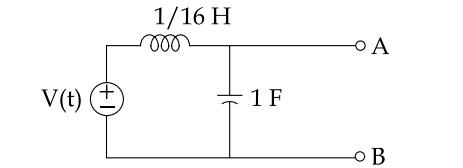
The circuit shown below, will act as an ideal current source with respect to terminals A and B when frequency is :
In RLC series circuit under variable frequency, what is initially negative and becomes zero and then positive?
Which of the following is NOT the property of a parallel resonant RLC circuit?
Consider the following statements and choose the correct answer:
Statement 1: In an RLC series circuit, at half-power frequencies the magnitude of total reactance is equal to resistance.
Statement 2: In an RLC parallel circuit, at half-power frequencies the magnitude total susceptance is equal to conductance.


