
In RLC series circuit under variable frequency, what is initially negative and becomes zero and then positive?
Net reactance
Understanding Reactance in RLC Series Circuits
In a series RLC circuit, components like resistors (R), inductors (L), and capacitors (C) are connected in series. When an AC voltage is applied, each component offers opposition to the current flow. The opposition offered by inductors and capacitors is called reactance.Reactances and Frequency
The reactance values depend on the frequency ($\small f$) of the applied AC voltage:- Inductive Reactance ($\small X_L$): This is the opposition offered by an inductor. It is directly proportional to the frequency and inductance ($\small L$). The formula is $\small X_L = 2\pi f L$. As frequency increases, $\small X_L$ increases. $\small X_L$ is always positive.
- Capacitive Reactance ($\small X_C$): This is the opposition offered by a capacitor. It is inversely proportional to the frequency and capacitance ($\small C$). The formula is $\small X_C = \frac{1}{2\pi f C}$. As frequency increases, $\small X_C$ decreases. $\small X_C$ is always positive.
Net Reactance ($X_{net}$)
In a series RLC circuit, the total or net reactance is the difference between the inductive reactance and the capacitive reactance.\small X_{net} = X_L - X_C
Substituting the formulas for $\small X_L$ and $\small X_C$:
\small X_{net} = 2\pi f L - \frac{1}{2\pi f C}
How Net Reactance Changes with Variable Frequency
Let's analyze how $\small X_{net}$ behaves as the frequency ($\small f$) varies:- At very low frequencies (f > 0): $\small X_L$ ($\small 2\pi f L$) is very small (approaching zero) because $\small f$ is small. $\small X_C$ ($\small \frac{1}{2\pi f C}$) is very large (approaching infinity) because $\small f$ is in the denominator. Therefore, $\small X_{net} = X_L - X_C$ will be dominated by the large negative value of $\small -X_C$. So, at very low frequencies, $\small X_{net}$ is largely negative.
- As frequency increases: $\small X_L$ increases linearly, while $\small X_C$ decreases inversely with frequency. There will be a specific frequency where $\small X_L$ becomes equal to $\small X_C$. This frequency is called the resonance frequency ($\small f_r$).
- At resonance frequency ($\small f_r$): $\small X_L = X_C$. At this point, $\small X_{net} = X_L - X_C = 0$.
- At very high frequencies: $\small X_L$ ($\small 2\pi f L$) is very large (approaching infinity) because $\small f$ is large. $\small X_C$ ($\small \frac{1}{2\pi f C}$) is very small (approaching zero) because $\small f$ is in the denominator. Therefore, $\small X_{net} = X_L - X_C$ will be dominated by the large positive value of $\small X_L$. So, at very high frequencies, $\small X_{net}$ is largely positive.
Examining Other Options
- Capacitive reactance ($\small X_C$): As discussed, $\small X_C$ starts very large at low frequency and decreases as frequency increases. It is always positive. It does not become negative or zero (unless frequency approaches infinity).
- Inductive reactance ($\small X_L$): As discussed, $\small X_L$ starts at zero (for f=0) and increases with frequency. It is always non-negative. It does not become negative.
- Impedance ($\small Z$): The impedance of an RLC series circuit is given by $\small Z = \sqrt{R^2 + (X_L - X_C)^2} = \sqrt{R^2 + X_{net}^2}$. Since $\small X_{net}^2$ is always non-negative, and $\small R^2$ is always non-negative, $\small Z$ is always non-negative. It is smallest at resonance ($\small Z=R$) and increases as frequency moves away from resonance. It does not become negative.
| Quantity | Behavior with Increasing Frequency | Fits Description? |
|---|---|---|
| Inductive Reactance ($\small X_L$) | Starts at 0, increases. Always $\small \ge 0$. | No |
| Capacitive Reactance ($\small X_C$) | Starts very large, decreases. Always $\small > 0$. | No |
| Net Reactance ($\small X_{net}$) | Starts negative, becomes 0 (at resonance), becomes positive. | Yes |
| Impedance ($\small Z$) | Starts large, decreases to minimum (R) at resonance, increases. Always $\small \ge 0$. | No |
Therefore, in an RLC series circuit under variable frequency, the Net reactance is initially negative, becomes zero at resonance, and then becomes positive.
Important Questions from Electrical Resonance
The lower and upper cut-off frequencies are also called as _______ frequencies.
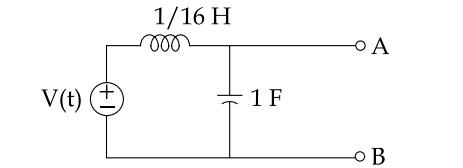
The circuit shown below, will act as an ideal current source with respect to terminals A and B when frequency is :
Which of the following is NOT the property of a parallel resonant RLC circuit?
A tuned amplifier has a voltage gain of 100 and a bandwidth of 10 KHz at 500 KHz. It is required to increase the bandwidth to 20 KHz. This can be achieved by which one of the following ways?
Consider the following statements and choose the correct answer:
Statement 1: In an RLC series circuit, at half-power frequencies the magnitude of total reactance is equal to resistance.
Statement 2: In an RLC parallel circuit, at half-power frequencies the magnitude total susceptance is equal to conductance.


