
The lower and upper cut-off frequencies are also called as _______ frequencies.
half power
Cut-off Frequencies Explained
The question asks for another name for the lower and upper cut-off frequencies. These frequencies are fundamental concepts in electronics, especially when dealing with filters, amplifiers, and signal processing.
Half-Power Frequencies: The Alternative Name
The lower and upper cut-off frequencies are also known as half-power frequencies. This term accurately describes the characteristic behavior of a system (like an amplifier or a filter) at these specific frequency points.
Here's why they are called half-power frequencies:
- Power Reduction: At the lower cut-off frequency (\(f_L\)) and the upper cut-off frequency (\(f_H\)), the output power of the system drops to half (\(1/2\)) of its maximum power output. If \(P_{max}\) is the maximum power, then at \(f_L\) and \(f_H\), the power output \(P_{out}\) is given by: \[P_{out} = \frac{P_{max}}{2}\]
- Voltage/Current Reduction: Since power is proportional to the square of voltage or current (\(P \propto V^2\) or \(P \propto I^2\)), when the power drops to half, the voltage or current amplitude drops to \(1/\sqrt{2}\) times its maximum value. \[V_{out} = \frac{V_{max}}{\sqrt{2}} \approx 0.707 \times V_{max}\] Similarly, \[I_{out} = \frac{I_{max}}{\sqrt{2}} \approx 0.707 \times I_{max}\] This means that at the half-power frequencies, the output voltage or current is about 70.7% of its maximum value.
- Decibel (dB) Point: In terms of decibels, a 50% reduction in power corresponds to a -3 dB change. This is because \(10 \log_{10}(P_{out}/P_{max}) = 10 \log_{10}(1/2) \approx -3.01\) dB. Hence, half-power frequencies are also commonly referred to as the -3 dB frequencies.
Significance of Half-Power Frequencies
These half-power frequencies are crucial for defining the bandwidth of a system. The bandwidth (BW) is the range of frequencies over which the system operates effectively, and it is calculated as the difference between the upper and lower cut-off frequencies:
\[BW = f_H - f_L\]
For example, in a band-pass filter, signals within this bandwidth are passed with minimal attenuation, while signals outside this range are significantly attenuated. Similarly, for an amplifier, these frequencies define the range over which the amplifier provides effective gain.
Summary of Key Terms
To summarize, the lower and upper cut-off frequencies are interchangeably called:
- Half-power frequencies
- -3 dB frequencies
Therefore, based on the options provided, the correct term is "half power".
Important Questions from Electrical Resonance
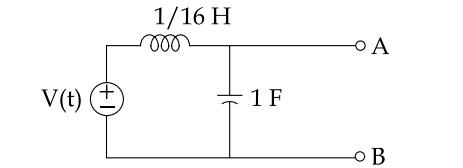
The circuit shown below, will act as an ideal current source with respect to terminals A and B when frequency is :
In RLC series circuit under variable frequency, what is initially negative and becomes zero and then positive?
Which of the following is NOT the property of a parallel resonant RLC circuit?
A tuned amplifier has a voltage gain of 100 and a bandwidth of 10 KHz at 500 KHz. It is required to increase the bandwidth to 20 KHz. This can be achieved by which one of the following ways?
Consider the following statements and choose the correct answer:
Statement 1: In an RLC series circuit, at half-power frequencies the magnitude of total reactance is equal to resistance.
Statement 2: In an RLC parallel circuit, at half-power frequencies the magnitude total susceptance is equal to conductance.


