
The above circuit is operated at 120 V – 60 Hz supply and the load resistance R = 20 Ω, L = 40 mH, delay angles are α1 = 60°, α2 = 120°. The value of : (A) Peak circulating current = 11.250 A Choose the most appropriate answer from the options given below :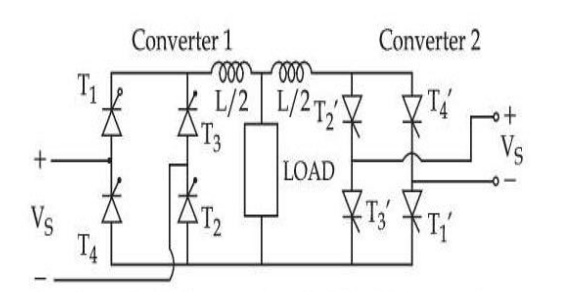
(B) Peak circulating current = 6.250 A
(C) Peak current of converter 1 = 8.485 A
(D) Peak current of converter 1 = 19.735 A
(A) and (D) Only
A circulating-current dual converter carries two separate currents, and the converter's own peak is the sum of them.
Step 1 — the peak circulating current. The instantaneous difference between the two converters' output voltages drives current through the reactor, and its peak is
\(i_{r,max}=\dfrac{2V_{m}}{\omega L}\left(1-\cos\alpha_{1}\right)\)
With \(V_{m}=120\sqrt{2}=169.7\) V and \(\omega L=2\pi\times60\times0.04=15.08\ \Omega\):
\(\dfrac{2\times169.7}{15.08}=22.5\ \text{A}\)
\(i_{r,max}=22.5\times\left(1-\cos60^{\circ}\right)=22.5\times0.5=11.25\ \text{A}\)
— statement (A).
Step 2 — the peak load current. The load is resistive as far as the peak is concerned:
\(I_{L,max}=\dfrac{V_{m}}{R}=\dfrac{169.7}{20}=8.485\ \text{A}\)
Step 3 — the peak current in converter 1. This is the crucial step, and it is what separates (C) from (D). The conducting converter carries the load current and the circulating current at the same time:
\(I_{p1}=I_{L,max}+i_{r,max}=8.485+11.25=19.735\ \text{A}\)
— statement (D). Statement (C) quotes 8.485 A, which is the load current alone and therefore understates what the thyristors must carry.
Why that distinction matters in design. The circulating current here is larger than the load current itself, so sizing the thyristors on load current alone would under-rate them by more than a factor of two. It is the single most important consequence of choosing the circulating-current mode.
Why circulating current is tolerated at all. The two converters are fired so that \(\alpha_{1}+\alpha_{2}=180^{\circ}\) — here 60° and 120° — which makes their average output voltages equal and lets both conduct continuously. Because current never falls to zero, the converter passes smoothly through zero load current with no dead time and no discontinuous-conduction distortion, giving a fast, four-quadrant drive. The price is the reactor, the extra thyristor rating and the wasted circulating power. The alternative circulating-current-free mode fires only one converter at a time and needs a changeover delay instead.
Hence, the correct statements are (A) and (D).
Similar Questions
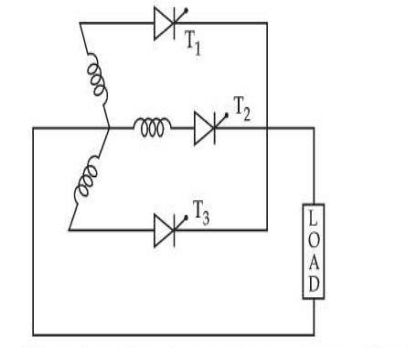
For the circuit given, phase voltage is Vm sin ωmt, where Vm is the peak phase voltage. The value of maximum average output voltage that occurs at a delay angle α = 0 is given by :
In a two quadrant single phase SCR Drive armature current becomes continuous when :
In one quadrant converters such as half controlled bridge circuit or single phase circuit with fly wheel diodes for DC moter.
The reading of an ac ammeter connected to a half controlled rectifier with firing angle α = 0 will be :
In a fully controlled three phase bridge without fly wheel operation the displacement factor and power factor is :
Important Questions from Phase Controlled Rectifiers
- Which of the following is control element in Silicon Controlled Resistor (SCR)?
A 240 V single-phase AC supply is fed to a load resistor of 100 Ω through a thyristor. If the thyristor is fired at 90°, what is the power consumed by the load?
The maximum firing angle that can be obtained by a pure resistive trigger circuit used in phase control circuit is:
In a 3-phase converter circuit, during commutation when one SCR in one phase is turned on, turning of an SCR in another phase results is:
- Which mode is described when the anode is assigned a positive voltage, the gate is assigned a zero voltage disconnected and the cathode is assigned a negative voltage?



