
In phase control and Integral cycle control the supply voltage is ac and the armature voltage is rectified ac, where as in chopper control the supply is dc and the average armature voltage is proportional to the duty ratio of the chopper. The chopper system is used for dc traction & battery operated vehicle - Choppers using thyristors are more complicated than the phase control system. This is because an auxiliary commutation arrangement is necessary for choppers, whereas commutation is natural owing to a.c. supply in phase control or integral cycle control. Read the paragraph carefully and answer the question based on it.
In a two quadrant single phase SCR Drive armature current becomes continuous when :
$\beta-\alpha$ is equal to or greater than $180^o$
Step-by-step Solution with Explanation:
In a two-quadrant single-phase SCR drive, the armature current becomes continuous under certain conditions. Let's analyze these conditions step-by-step:
Understanding the Control Method: In phase-controlled rectifiers used in SCR drives, the conduction angle of the SCR determines how much voltage is applied to the motor. The conduction range, referred to as \((\beta - \alpha)\), affects the current characteristics in the circuit.
Continuous Armature Current: Continuous armature current occurs when the SCR remains "on" for a longer duration, allowing continuous current flow through the motor. This typically happens when the conduction angle is large enough to prevent the current from dropping to zero during the non-conduction period.
Evaluating the Options: We need to identify under which condition the armature current remains continuous:
- \(\beta - \alpha\) is equal to or greater than \(180^\circ\): This implies a full or nearly full conduction cycle, leading to continuous current flow.
- \(\beta - \alpha\) is less than \(90^\circ\): This results in very brief conduction periods, leading to discontinuous current.
- \(\beta - \alpha\) is greater than \(90^\circ\) but less than \(120^\circ\): While better than the previous, it still might not ensure continuous current.
- \(\beta - \alpha\) is less than \(45^\circ\): This is too short to sustain continuous current.
Conclusion: The correct condition for continuous armature current in this drive system is when \(\beta - \alpha\) is equal to or greater than \(180^\circ\).
Final Answer: The armature current becomes continuous when \(\beta-\alpha\) is equal to or greater than \(180^\circ\).
Similar Questions
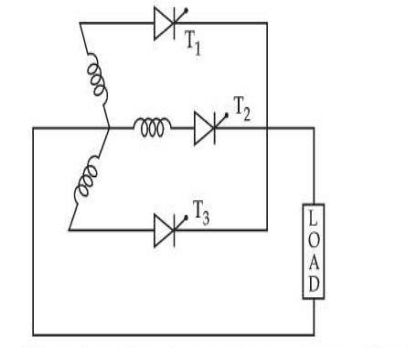
For the circuit given, phase voltage is Vm sin ωmt, where Vm is the peak phase voltage. The value of maximum average output voltage that occurs at a delay angle α = 0 is given by :
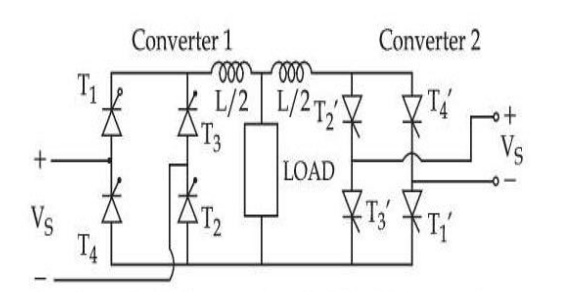
The above circuit is operated at 120 V – 60 Hz supply and the load resistance R = 20 Ω, L = 40 mH, delay angles are α1 = 60°, α2 = 120°. The value of :
(A) Peak circulating current = 11.250 A
(B) Peak circulating current = 6.250 A
(C) Peak current of converter 1 = 8.485 A
(D) Peak current of converter 1 = 19.735 AChoose the most appropriate answer from the options given below :
In one quadrant converters such as half controlled bridge circuit or single phase circuit with fly wheel diodes for DC moter.
The reading of an ac ammeter connected to a half controlled rectifier with firing angle α = 0 will be :
In a fully controlled three phase bridge without fly wheel operation the displacement factor and power factor is :
Important Questions from Phase Controlled Rectifiers
- Which of the following is control element in Silicon Controlled Resistor (SCR)?
A 240 V single-phase AC supply is fed to a load resistor of 100 Ω through a thyristor. If the thyristor is fired at 90°, what is the power consumed by the load?
The maximum firing angle that can be obtained by a pure resistive trigger circuit used in phase control circuit is:
In a 3-phase converter circuit, during commutation when one SCR in one phase is turned on, turning of an SCR in another phase results is:
- Which mode is described when the anode is assigned a positive voltage, the gate is assigned a zero voltage disconnected and the cathode is assigned a negative voltage?



